History Resume: Complete Guide with Examples (2026)
History resume guide for 2026. Learn resume vs CV, skills to include, how to quantify research impact, and see a complete history resume example.
History Resume: Complete Guide with Examples (2026)
According to the Bureau of Labor Statistics (BLS), historians earn a median annual wage of $76,750 ($36.90/hour), with the top 10% earning more than $131,340. There are approximately 3,800 historians employed in the United States, and employment is projected to grow 3% from 2025 to 2035.
According to the American Historical Association (AHA), in an interview with Richard Gillespie, director of education for the Mosby Heritage Area Association:
> "The number one thing I would say is as early as possible you want to start to prepare a resume to show that you've been involved in history. People don't care what school you went to or what your history degree is in, but if you have a resume that shows you've done a bunch of stuff in history, you're going to be hirable."
According to the AHA's Career Readiness guide by Julia Brookins and Brendan Gillis:
> "Approach the job application process as you would an assignment in a history course. You have an opportunity to use evidence (personal experience) to support a thesis (I am qualified for this position) that will hopefully lead an employer to the conclusion that they should hire you."
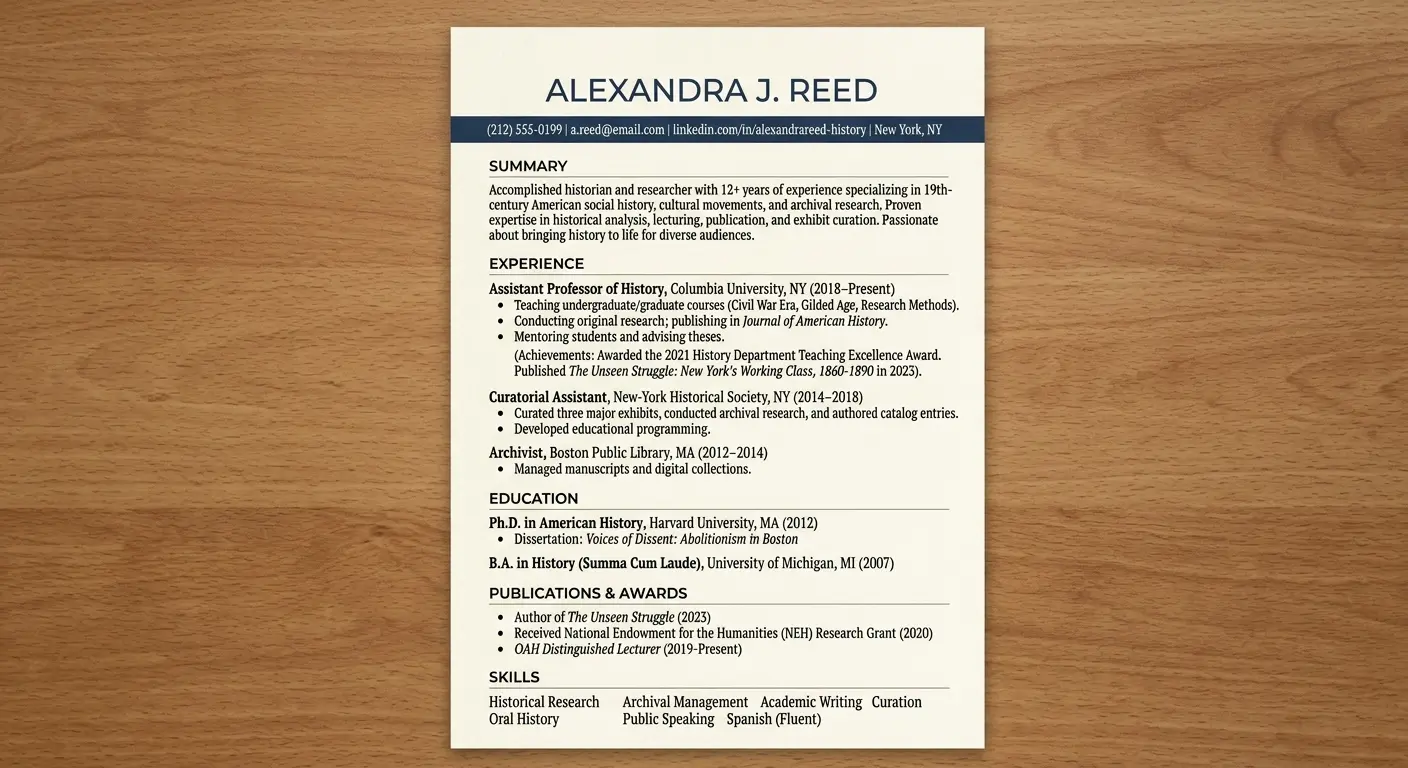
This guide covers everything you need to know about writing a history resume that translates your academic training into a compelling professional document.
“History Resume: Key Takeaways
- Median historian salary: $76,750 (BLS, May 2025)
- 3,800 historians employed in the U.S.
- 3% job growth projected (2025-2035)
- Use a resume for public history and non-academic roles
- Use a CV for academic and research positions
- Quantify research impact with numbers
- Avoid academic jargon for non-academic employers
- Grab every history opportunity you can (AHA)
- Translate your degree's value into employer language”
What You'll Learn in This Guide
- Resume vs CV for history professionals
- The right format for history resumes
- How to write a powerful resume summary
- Skills to include (hard, soft, transferable)
- How to quantify research impact
- A complete history resume example
- Common mistakes to avoid
Resume vs CV: Which One Do You Need?
According to the American Historical Association (AHA):
> "A résumé is a 1-2 page summary of your professional skills, experience, and education; a c.v. summarizes your educational and academic backgrounds as well as teaching and research experience, publications, presentations, awards, honors, affiliations, and other details."
According to Kickresume:
| Document | When to Use | Typical Length |
|---|---|---|
| Resume | Public history, museums, archives, nonprofits, government, business, education | 1-2 pages |
| CV | Academic history, research, professor, postdoc, fellowship applications | Multi-page (no limit) |
According to the AHA's Going on the Job Market guide:
> "Present your credentials and unique qualifications clearly, succinctly, and in descending order of importance. Tailor your c.v. to each position."
> "For public history positions, do consider adding a short 'Profile' section to the top of the c.v. that summarizes your major qualifications in three to five bulleted points."
History Resume Format
According to Kickresume, choose your format based on your experience level:
| Format | Best For | Why |
|---|---|---|
| Reverse-Chronological | Most job seekers with relevant experience | ATS-friendly, recruiters prefer it |
| Functional (Skills-Based) | Career changers, gaps, limited experience | Emphasizes skills over job history |
| Combination | Experienced professionals with diverse skills | Balances skills and experience |
According to the AHA:
> "Adapt your language for a busy, nonacademic reader: short and clear, with no jargon, but using some of the terms that are common in the industry where you want to work."
How to Write a History Resume Summary
According to JobSprout.ai, a strong history resume summary looks like this:
> "Highly accomplished Historian with 6 years of experience specializing in 20th-century American social and political history, with a strong focus on civil rights movements. Proven expertise in extensive archival research, critical historical analysis, and producing high-quality academic publications. Adept at lecturing, curriculum development, and presenting complex historical narratives to diverse audiences."
Summary Formula:
> [Title/Experience Level] with [X] years of experience specializing in [specialty]. Proven expertise in [key skill], [key skill], and [key skill]. Adept at [additional relevant skills].
According to the AHA's Talking to Employers essay by Loren Collins:
> "As job candidates, we cannot assume that potential employers understand the value our degrees represent. We must be able to articulate that value in order to close the gap in their understanding."
Skills for History Resumes
Hard Skills (Technical/Research)
According to JobSprout.ai and Kickresume:
| Category | Skills |
|---|---|
| Research Methods | Archival Research, Primary Source Analysis, Oral History, Qualitative Research, Research Design, Source Criticism |
| Analysis | Historical Analysis, Historiography, Textual Criticism, Data Interpretation, Contextual Analysis |
| Technical | Paleography, Manuscript Analysis, Digital Humanities, Database Management |
| Writing & Publishing | Academic Writing, Grant Writing, Report Writing, Peer Review |
| Preservation | Archiving Documents and Artifacts, Preserving Historical Materials, Authenticating Artifacts, Restoration Procedures |
Soft Skills
According to Kickresume:
| Soft Skill | Why It Matters |
|---|---|
| Attention to Detail | Historical accuracy depends on precision |
| Critical Thinking | Evaluating sources and interpretations |
| Written Communication | Reports, articles, and publications |
| Verbal Communication | Presentations, lectures, public engagement |
| Patience | Research can take months or years |
| Problem-Solving | Finding connections in fragmented evidence |
Transferable Skills from a History Degree
According to Prospects.ac.uk, the UK's official graduate careers website:
> "A degree in history develops your: critical reasoning and analytical skills, including the capacity for solving problems and thinking creatively; intellectual rigour and independence, including the ability to conduct detailed research; ability to construct an argument and communicate findings in a clear and persuasive manner, both orally and in writing; capability to work without direct supervision and manage your time and priorities effectively; ability to discuss ideas in groups, and to negotiate, question and summarise; capacity to think objectively and approach problems and new situations with an open mind."
| Transferable Skill | How to Present It |
|---|---|
| Critical Reasoning | "Analyzed competing historical interpretations to reach evidence-based conclusions" |
| Research Ability | "Conducted 12 months of archival research across 3 national collections" |
| Persuasive Communication | "Presented research findings to audiences of 50+ at academic conferences" |
| Independence | "Self-directed a 15,000-word thesis project from conception to completion" |
| Objectivity | "Evaluated primary sources from multiple perspectives to avoid bias" |
How to Quantify Research Impact
According to Resumly, the biggest mistake history professionals make is failing to quantify their achievements.
Before (Weak):
> "Published articles on medieval trade routes."
After (Strong):
> "Published 5 peer-reviewed articles on medieval trade routes, cited 120 times, and secured a $30,000 research grant."
Quantification Cheat Sheet:
| Achievement Type | What to Quantify |
|---|---|
| Publications | Number of articles, books, chapters |
| Citations | Total citations, h-index |
| Grants | Amount secured, funding bodies |
| Presentations | Number given, audience size |
| Research | Archives visited, documents analyzed, months of research |
| Teaching | Students taught, courses designed |
| Public History | Exhibits curated, visitors reached |
Translating Academic Language
According to Resumly:
> "Hiring managers may not understand specialized terminology. ATS may not recognize niche phrases. Makes the resume feel inaccessible."
Before:
> "Conducted a diachronic analysis of epigraphic corpora utilizing palaeographic stratigraphy."
After:
> "Analyzed ancient inscriptions over time using modern dating techniques to uncover historical trends."
Complete History Resume Example
“EMILY CARTER
(555) 123-4567 | emily.carter@email.com | Boston, MA
[LinkedIn URL]
PROFESSIONAL SUMMARY
Historian with 6 years of experience specializing in 19th-century American social history. Expertise in archival research, digital humanities, and public history programming. Published author with 3 peer-reviewed articles and 2 museum exhibitions curated. Committed to making historical scholarship accessible to diverse audiences.
CORE COMPETENCIES
Archival Research | Primary Source Analysis | Historiography | Digital Humanities | Oral History | Academic Writing | Exhibit Curation | Public Programming | Grant Writing | Museum Collections Management
PROFESSIONAL EXPERIENCE
Public Historian | Boston Historical Society | Boston, MA | 2022-Present
- Curated 2 major exhibitions reaching 45,000+ visitors, securing $85,000 in grant funding
- Developed K-12 educational programs serving 1,200+ students across 15 schools
- Managed archival digitization project preserving 8,000+ documents
- Conducted 25+ oral history interviews for community memory project
- Published 3 peer-reviewed articles in journals including the Journal of American History
Research Assistant | Harvard University History Department | Cambridge, MA | 2019-2022
- Conducted archival research across 6 national repositories for professor's book project
- Analyzed 2,000+ primary documents spanning 1780-1920
- Co-authored 2 scholarly articles on labor history
- Presented research at 4 national conferences with audiences of 50+ scholars
EDUCATION
Master of Arts in History
Harvard University | Cambridge, MA | 2019
Thesis: "Labor and Community in Industrial New England, 1840-1900"
Bachelor of Arts in History
Boston College | Chestnut Hill, MA | 2017
Summa Cum Laude | GPA: 3.9
PUBLICATIONS
- Carter, E. (2025). "Community and Resistance in Industrial New England." Journal of American History, 112(3), 445-467.
- Carter, E. (2024). "Labor Migration and Family Networks in the 19th Century." Labor History, 65(2), 201-219.
AWARDS & HONORS
- Excellence in Public History Award, National Council on Public History | 2025
- Research Grant, Massachusetts Historical Society | $15,000 | 2024
- Graduate Fellowship, Harvard University | 2017-2019
PROFESSIONAL AFFILIATIONS
- American Historical Association (AHA)
- National Council on Public History (NCPH)
- Organization of American Historians (OAH)”
History CV Example (Academic)
“DR. JAMES MITCHELL
Department of History | University of Michigan | Ann Arbor, MI
(555) 987-6543 | james.mitchell@umich.edu
ACADEMIC APPOINTMENTS
Associate Professor of History | University of Michigan | 2021-Present
Assistant Professor of History | University of Michigan | 2016-2021
EDUCATION
Ph.D. in History | Yale University | 2016
M.A. in History | Yale University | 2012
B.A. in History | University of Chicago | 2010, Phi Beta Kappa
PUBLICATIONS
Books
- Mitchell, J. (2023). The Republic of Labor: Work and Politics in the American Midwest. Oxford University Press.
Peer-Reviewed Articles
- Mitchell, J. (2025). "Worker Solidarity in the Gilded Age." American Historical Review, 130(1), 45-72.
- Mitchell, J. (2023). "The Great Railroad Strike Reconsidered." Journal of American History, 110(4), 789-812.
- Mitchell, J. (2021). "Midwestern Populism and the Labor Movement." Labor History, 62(3), 334-358.
RESEARCH GRANTS
- National Endowment for the Humanities Fellowship | $60,000 | 2024-2025
- Andrew W. Mellon Foundation Grant | $45,000 | 2022-2023
CONFERENCE PRESENTATIONS
- "Labor and Community in the Industrial Midwest," American Historical Association Annual Meeting | 2025
- "The Politics of Work in the Gilded Age," Organization of American Historians | 2024
- "Midwestern Workers and the Populist Movement," Social Science History Association | 2023”
Common History Resume Mistakes
According to Resumly:
| Mistake | Why It Hurts | Fix It |
|---|---|---|
| Overly academic jargon | Hiring managers may not understand; ATS may not recognize | Replace with plain-language equivalents |
| Missing quantifiable achievements | Recruiters can't gauge impact | Add metrics: publications, grants, citations |
| Chronological gaps unexplained | Employers assume instability | Label as 'Independent Scholar' or 'Research Sabbatical' |
| Unclear career objective | Doesn't tell employer what role you're targeting | Write a 2-sentence headline with desired position |
| Using a CV for non-academic roles | Too long and academically focused | Convert to a 1-2 page resume for public history roles |
Expert Quotes to Remember
“"As early as possible you want to start to prepare a resume to show that you've been involved in history. People don't care what school you went to or what your history degree is in, but if you have a resume that shows you've done a bunch of stuff in history, you're going to be hirable."”
“"Approach the job application process as you would an assignment in a history course. You have an opportunity to use evidence (personal experience) to support a thesis (I am qualified for this position)."”
“"As job candidates, we cannot assume that potential employers understand the value our degrees represent. We must be able to articulate that value in order to close the gap in their understanding."”
“"A degree in history develops your critical reasoning and analytical skills, including the capacity for solving problems and thinking creatively; intellectual rigour and independence, including the ability to conduct detailed research."”
“"Published 5 peer-reviewed articles on medieval trade routes, cited 120 times, and secured a $30,000 research grant."”
Sources & References
- Bureau of Labor Statistics (BLS) — Historian salary, job outlook, and duties
- American Historical Association (AHA) — Career readiness, resume vs CV guidance, and expert interviews
- Prospects.ac.uk — History degree skills and career outcomes
- JobSprout.ai — History resume examples and skills
- Kickresume — Historian resume samples and format guidance
- Resumly — Common resume mistakes and before/after examples
Conclusion: Translate Your History Training Into a Winning Resume
According to the Bureau of Labor Statistics, historians earn a median annual wage of $76,750, and employment is projected to grow 3% from 2025 to 2035. According to the AHA:
> "Grab every history opportunity you can get your hands on."
Key Takeaways:
- Use a resume for public history and non-academic roles
- Use a CV for academic and research positions
- Quantify research impact with numbers
- Translate academic jargon into plain language
- Highlight transferable skills from your degree
- Tailor your resume for each position
- Build your resume early with history experience
Action Steps for Today:
1. Decide whether you need a resume or CV for your target roles
2. Write a 3-5 bullet professional profile
3. List your hard skills, soft skills, and transferable skills
4. Quantify your research achievements
5. Translate any academic jargon into plain language
6. Add publications, grants, and presentations (for CV)
7. Build your ATS-friendly resume with our ATS CV Maker
Should I use a resume or CV for history jobs?
According to the American Historical Association, 'a resume is a 1-2 page summary of your professional skills, experience, and education; a CV summarizes your educational and academic backgrounds as well as teaching and research experience, publications, presentations, awards, honors, and affiliations.' Use a resume for public history, museums, and non-academic roles. Use a CV for academic, research, and professor positions.
What skills should I put on a history resume?
According to Prospects.ac.uk, a history degree develops critical reasoning, analytical skills, intellectual rigour, research ability, and communication. Include hard skills like archival research, primary source analysis, and historiography alongside soft skills like attention to detail, critical thinking, and written communication.
How do I quantify research experience on a history resume?
According to Resumly, instead of saying 'published articles on medieval trade routes,' say 'Published 5 peer-reviewed articles on medieval trade routes, cited 120 times, and secured a $30,000 research grant.' Use numbers for publications, citations, grants, audience sizes, and archive collections handled.
What is the median salary for historians?
According to the Bureau of Labor Statistics (May 2025), the median annual wage for historians is $76,750 ($36.90/hour). The top 10% earn more than $131,340, while the bottom 10% earn less than $46,590. Employment is projected to grow 3% from 2025 to 2035.
How do I write a history resume with no experience?
According to the American Historical Association, 'as early as possible you want to start to prepare a resume to show that you've been involved in history.' Focus on coursework, thesis projects, volunteer work at local historical societies, archival internships, and transferable skills from your degree. The AHA recommends 'grab every history opportunity you can get your hands on.'
About the Author
Ash is a resume expert and career strategist who helps history graduates, researchers, and academics translate their training into compelling resumes and CVs. Ash's work has been cited in leading career publications and trusted by job seekers worldwide.
Comments
Loading comments…