How to Make a Resume Stand Out: 5 Research-Backed Strategies
Learn how to make a resume stand out with research-backed strategies from HR experts. Proven tips to beat ATS, get noticed, and land more interviews.
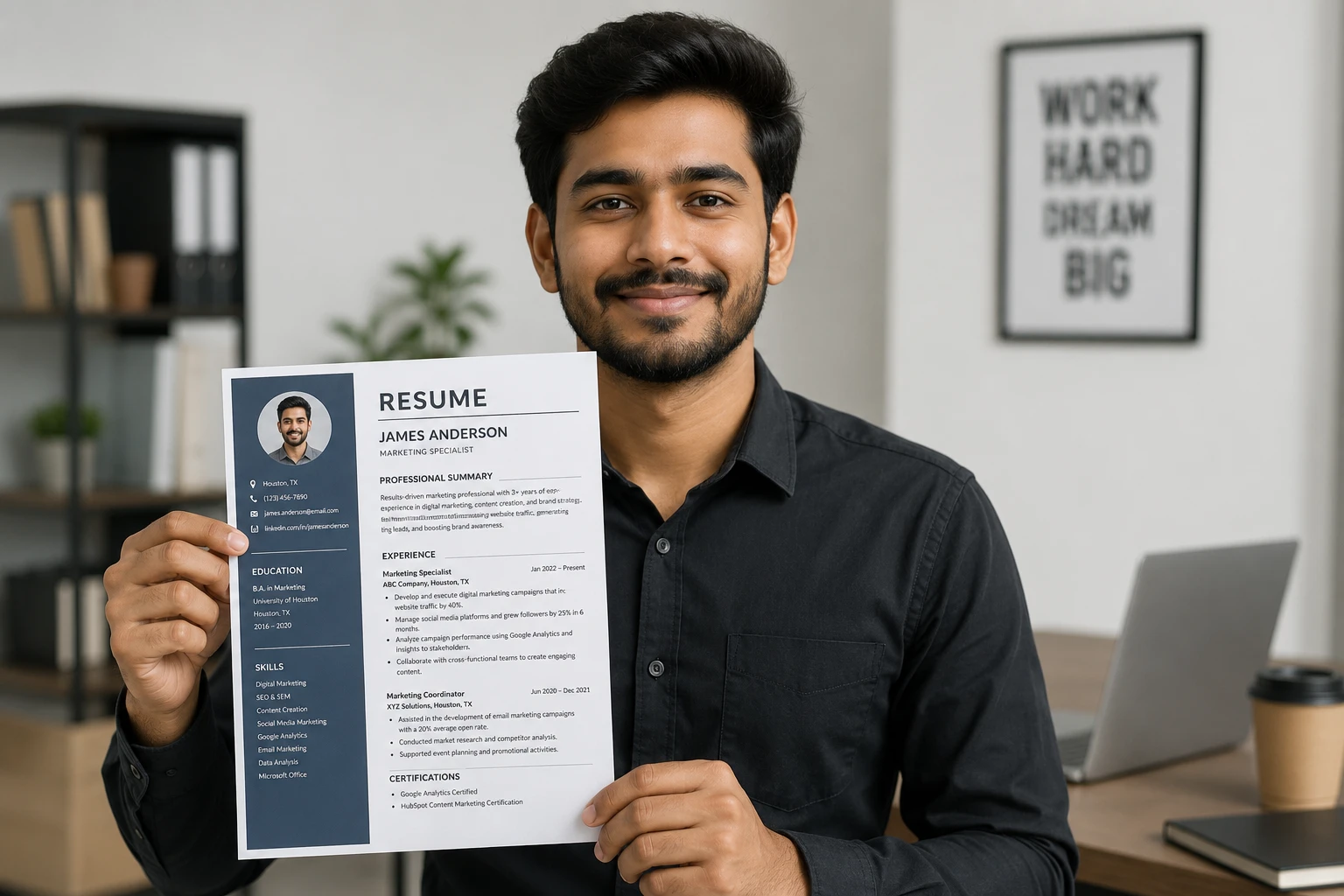
Introduction: The 11-Second Reality
Your resume has 6 to 11 seconds to make an impression. According to Gallup research and InterviewPal data, recruiters spend an average of just 11.2 seconds scanning a resume before deciding whether to move forward. Some studies suggest the number is even lower—around 6 seconds.
With more than 28% of Americans searching for new opportunities, the competition is fierce. In this environment, knowing how to make a resume stand out is not optional—it is essential.
This guide provides research-backed strategies from HR experts, career coaches, and data from the National Association of Colleges and Employers (NACE), Forbes, and Gallup. Whether you are a recent graduate or an experienced professional, these proven tactics will help you get noticed and land more interviews.
“How to Make a Resume Stand Out — Key Takeaways
Keep it organized and scannable (11-second scan)
Tailor your resume to the job description (keywords matter)
Use action-oriented phrasing with quantifiable metrics
Highlight relevant education and certifications
Proofread carefully (typos = rejection)
41% of recruiters look at skills section first
Show soft skills (90% of employers seek problem-solving)”
What You'll Learn in This Guide
- The 5 research-backed strategies to make your resume stand out
- Expert quotes from HR leaders at Microsoft, Indeed, and Gallup
- How to beat ATS screening with the right keywords
- Before and after examples showing real transformations
- Common mistakes that kill your chances—and how to avoid them
- Actionable tips you can implement today
The 5 Strategies to Make Your Resume Stand Out
1. Keep It Organized and Scannable
With only 6 to 11 seconds to make an impression, your resume must be easy to scan. Recruiters don't have time to navigate through complex formatting or dense paragraphs.
According to Sabina Nawaz, former HR executive at Microsoft:
"The goal of a resume is to differentiate yourself from others. When you make general statements, you don't stand out in the herd."
How to Keep Your Resume Organized:
- Use a clean, professional font like Arial, Calibri, or Times New Roman (10-12pt)
- Keep your resume to one page (if you have less than 10 years of experience)
- Use bullet points instead of paragraphs
- Use white space strategically to improve readability
- Use bold text for key metrics and job titles
- Keep your background white and text black
Expert Insight:
Cristian Gherghel, an HBS Online Community member, advises:
"Resume structure needs to be coherent and ideally one page. Use succinct bullet points to make it easier to skim and navigate your experience."
Before vs After: Organization
| Before (Weak) | After (Strong) |
|---|---|
| Dense paragraphs with no white space | Clean bullet points with ample white space |
| Multiple fonts and colors | Consistent font and professional colors |
| 3+ pages of content | 1-2 pages of relevant content |
Example:
Before: A 3-page resume with dense paragraphs, multiple fonts, and no clear structure.
After: A clean 1-page resume with bullet points, bold metrics, and clear section headers.
2. Tailor Your Resume to the Job Description
Generic resumes are easily overlooked. According to Parthsinh Rathod, an HBS Online Community member:
"Generic resumes that lack tailoring to specific job descriptions and important keywords may cause the resume to be overlooked."
With 71% of hiring managers using AI-powered software to filter candidates, keywords are more important than ever.
How to Tailor Your Resume:
- Read the job description carefully
- Highlight keywords that appear most frequently
- Include those keywords naturally in your summary, skills, and experience sections
- Use the exact language from the job description
- Prioritize the most relevant experience
Expert Insight:
Priya Rathod, Indeed's Workplace Trends Expert, explains:
"One smart way to use AI when crafting your resume is to keyword match your document with the job description to ensure your application makes it to the next round."
Joy Nath, another HBS Community member, adds:
"Including relevant keywords from the job posting is crucial in today's digital recruiting landscape. It enables the resume to pass through applicant tracking systems."
Before vs After: Tailoring
| Before (Weak) | After (Strong) |
|---|---|
| "Managed social media accounts" | "Managed social media accounts for 5 brands, growing follower base by 40%" |
| "Worked on marketing campaigns" | "Developed and executed marketing campaigns generating $2M in revenue" |
Example:
Before: "Supported marketing initiatives and helped with content creation."
After: "Led content marketing strategy for 3 product launches, increasing organic traffic by 45% and generating 200+ qualified leads monthly."
3. Use Action-Oriented Phrasing with Quantifiable Metrics
Hiring managers don't just want to know what you were responsible for. They want to know what changed because of your work.
According to Sho Dewan, Career Expert and Forbes Contributor:
"Your resume is more than a listing of past jobs and duties. It's one of the most direct ways you show decision makers what you can do. Hiring managers don't just want to know what you were responsible for. They want to know what changed because of your work."
Sabina Nawaz, former Microsoft HR executive, adds:
"Every bullet point should answer: 'What was the impact? What was the result of you doing that thing?'"
How to Use Action-Oriented Phrasing:
- Start every bullet point with a powerful action verb
- Include quantifiable metrics (numbers, percentages, dollars)
- Show the impact of your work
- Avoid passive language
Before vs After: Action-Oriented Phrasing
| Before (Weak) | After (Strong) |
|---|---|
| "Increased sales" | "Increased sales by 30% within six months" |
| "Managed a team" | "Led a team of 12 sales professionals, achieving 35% revenue growth" |
| "Worked with co-workers" | "Collaborated with cross-functional teams to develop six business proposals annually" |
Example:
Before: "Worked with co-workers to develop business proposals."
After: "Collaborated with cross-functional teams to develop six business proposals annually that led to a 30% increase in profits year-over-year."
As Joy Nath explains:
"Phrases like 'Increased sales by 30 percent within six months' not only demonstrate the candidate's impact but also provide concrete evidence of their capabilities."
4. Avoid Typos and Errors
A sloppy resume reflects on your job performance. If typos persist throughout your resume, hiring managers will assume your work is also error-prone.
How to Avoid Typos and Errors:
- Proofread your resume multiple times
- Read it aloud to catch awkward phrasing
- Use spell-check tools (Grammarly, Wordtune)
- Ask a friend or colleague to review it
- Check for consistency in formatting
Before vs After: Proofreading
| Before (Weak) | After (Strong) |
|---|---|
| "Managed a team of 12 profesionals" | "Managed a team of 12 professionals" |
| "Increased sales by 30% anualy" | "Increased sales by 30% annually" |
| "Lead a project to improve effiency" | "Led a project to improve efficiency" |
5. Highlight Your Education and Certifications
If you're missing a few years of experience or key requirements, your education can help fill the gap. According to Harvard Business School Online, online learning opportunities are ideal if you want to gain new skills without putting your job on hold.
How to Highlight Your Education:
- Include your degree(s) with institution name and graduation year
- List relevant certifications and licenses
- Include online learning programs (with completion dates)
- Add relevant coursework if applicable
Examples of Education Section:
Harvard Business School Online
CORe: Credential of Readiness, [Grade]
[Cohort Start Month and Year]
Expert Insight:
Roshaunda Green, Senior Talent Acquisition Partner at Pitney Bowes, advises:
"Candidates should clearly explain at the top of their resume how their experience aligns with the job's required skills. You should be able to show that you meet at least 80% of the requirements without recruiters having to connect the dots."
Before vs After: Complete Resume Transformation
| Before (Weak) | After (Strong) |
|---|---|
| "Managed social media accounts" | "Managed social media accounts for 5 brands, growing follower base by 40%" |
| "Worked on marketing campaigns" | "Developed and executed marketing campaigns generating $2M in revenue" |
| "Helped with content creation" | "Created 50+ blog posts and 30 videos, increasing organic traffic by 45%" |
| "Supported the marketing team" | "Collaborated with 8 cross-functional team members to deliver 12 projects on time" |
| "Did data analysis" | "Analyzed customer data from 5 sources, identifying trends that increased retention by 25%" |
| "Assisted with event planning" | "Planned and executed 10+ corporate events with 100+ attendees, achieving 95% satisfaction" |
Common Mistakes to Avoid
- Sending Generic Resumes: Always tailor your resume to the specific job description. According to Parthsinh Rathod, generic resumes are easily overlooked.
- Using Passive Language: Avoid 'helped,' 'worked on,' or 'assisted with' without context. Use action verbs and quantify your achievements.
- Forgetting Keywords: With 71% of hiring managers using AI-powered screening, missing keywords means missing opportunities.
- Overlooking Soft Skills: NACE data shows 90% of employers seek problem-solving skills and 80% seek teamwork skills.
- Making Typos: A single typo can disqualify you. Proofread carefully.
- Including Irrelevant Information: Keep your resume focused on the role you're applying for.
- Being Too Vague: Generic statements like 'hard worker' say nothing about you. Use specific examples and metrics.
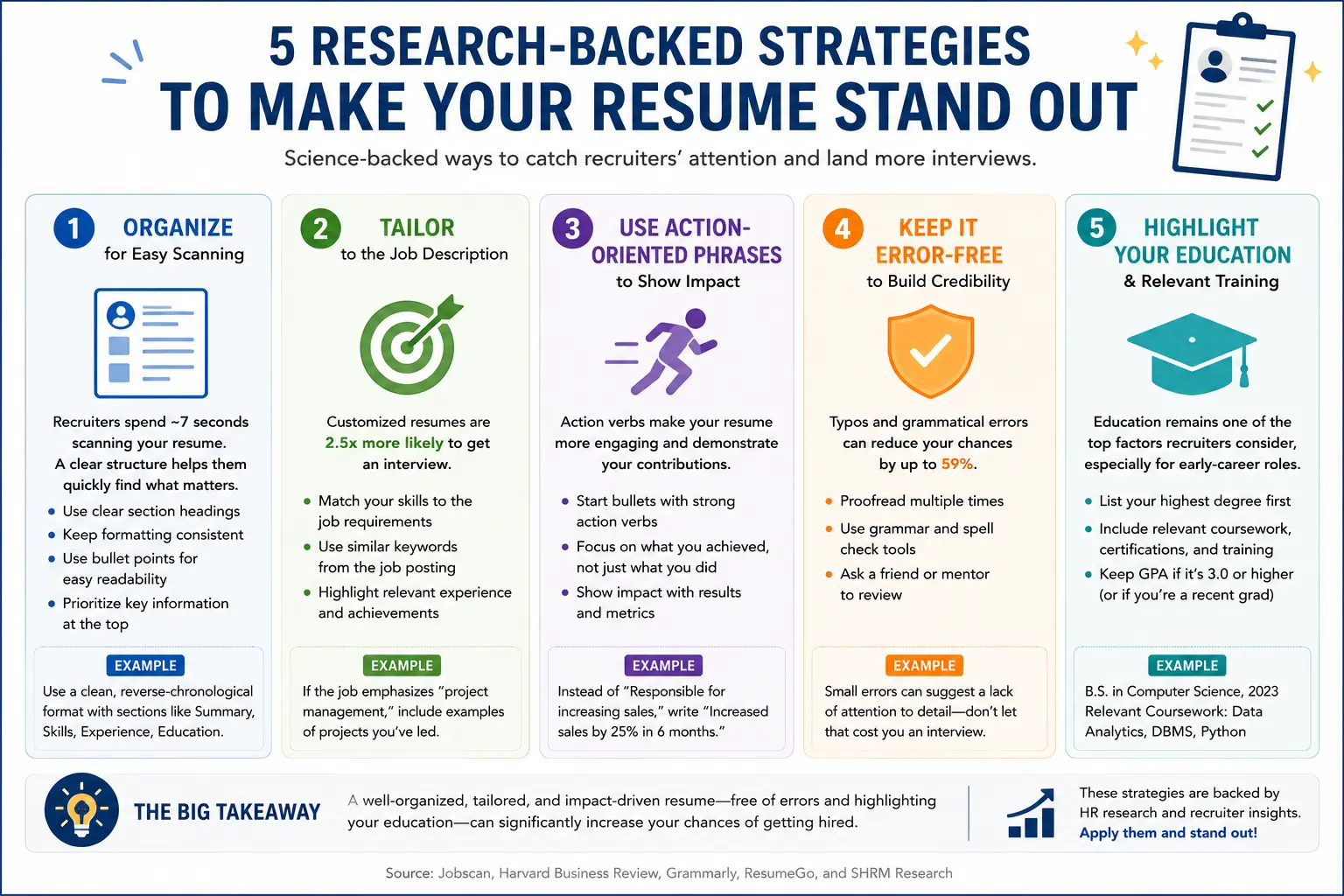
Resume Stand Out Strategies Infographic
Visual infographic showing the 5 research-backed strategies to make your resume stand out: organization, tailoring, action-oriented phrasing, error-free, and education.
Expert Quotes to Remember
Here are the most powerful quotes from our research. Use them as reminders when crafting your resume.
“"The goal of a resume is to differentiate yourself from others. When you make general statements, you don't stand out in the herd."”
“"Every bullet point should answer: What was the impact? What was the result of you doing that thing?"”
“"Hiring managers don't just want to know what you were responsible for. They want to know what changed because of your work."”
“"One smart way to use AI when crafting your resume is to keyword match your document with the job description."”
“"Candidates should clearly explain at the top of their resume how their experience aligns with the job's required skills. You should be able to show that you meet at least 80% of the requirements without recruiters having to connect the dots."”
“"Passion matters more than polish."”
Conclusion: Make Your Resume Stand Out Today
Your resume is your first impression. With only 6 to 11 seconds to capture a recruiter's attention, you need to make every word count.
By following these 5 research-backed strategies—keeping it organized, tailoring to the job description, using action-oriented phrasing with metrics, avoiding errors, and highlighting your education—you can create a resume that stands out from the competition.
Remember the words of Sabina Nawaz:
"The goal of a resume is to differentiate yourself from others. When you make general statements, you don't stand out in the herd."
Action Steps for Today:
1. Review your resume and apply these 5 strategies
2. Tailor your resume for your next application
3. Quantify your achievements with metrics
4. Proofread carefully
5. Build your ATS-friendly resume with our ATS CV Maker
How long do recruiters actually spend looking at a resume?
According to Gallup research and InterviewPal data, recruiters spend an average of just 6 to 11.2 seconds scanning a resume before deciding whether to move forward. This is why having a scannable, organized resume with clear sections and bold metrics is critical.
What do recruiters look at first on a resume?
According to career expert Sho Dewan, 41% of recruiters look at the skills section first. Additionally, 76% of companies use Applicant Tracking Systems (ATS) to filter candidates by skills. This means your skills section should be prominent and tailored to the job description.
How important are keywords on a resume?
Extremely important. According to Forbes, about 71% of hiring managers use AI-powered software to filter candidates. Including relevant keywords from the job description helps your resume pass ATS screening and get in front of human recruiters.
What soft skills do employers value most?
According to the National Association of Colleges and Employers (NACE) Job Outlook 2025 survey, nearly 90% of employers seek evidence of problem-solving skills, and nearly 80% are looking for strong teamwork skills. Communication and adaptability are also highly valued.
Should I use a resume template or create my own?
Using a professional resume template is recommended, as long as it's clean, ATS-friendly, and properly formatted. Avoid overly creative templates with graphics, tables, or columns that can confuse ATS systems. A simple, well-structured template is most effective.
How can I quantify my achievements on a resume?
Use numbers, percentages, and specific metrics to demonstrate impact. For example, instead of saying 'Managed a team,' say 'Led a team of 12 sales professionals, achieving 35% revenue growth and exceeding quarterly targets for 6 consecutive quarters.'
Should I include hobbies or personal interests on my resume?
According to Gallup expert Vibhas Ratanjee, passion matters more than polish. Including relevant hobbies or interests that demonstrate curiosity, initiative, or purpose can help you stand out—especially in creative or culture-driven roles.
Sources & References
- Gallup Research – https://www.gallup.com/workplace/
- InterviewPal – https://interviewpal.com/
- NBC News – https://www.nbcnews.com/business/economy/28-americans-are-now-searching-new-job-highest-rate-decade-rcna167368
- Forbes – https://www.forbes.com/
- National Association of Colleges and Employers (NACE) – https://www.naceweb.org/
- Sho Dewan – https://www.forbes.com/sites/shodewan/
- Sabina Nawaz – https://sabinanawaz.com/
- Priya Rathod – https://www.indeed.com/
- Roshaunda Green – https://www.pitneybowes.com/
- Vibhas Ratanjee – https://www.gallup.com/
About the Author
Ash is a resume expert and career strategist who helps job seekers land their dream roles. With years of experience in resume writing and ATS optimization, Ash has helped thousands of candidates create resumes that get noticed. Ash's work has been featured in leading career publications and is trusted by job seekers worldwide.
Comments
Loading comments…