How to Make a Resume on Google Docs: Step-by-Step Guide
Learn how to make a resume on Google Docs with this step-by-step guide. Access templates, customize your resume, and download as PDF for job applications.
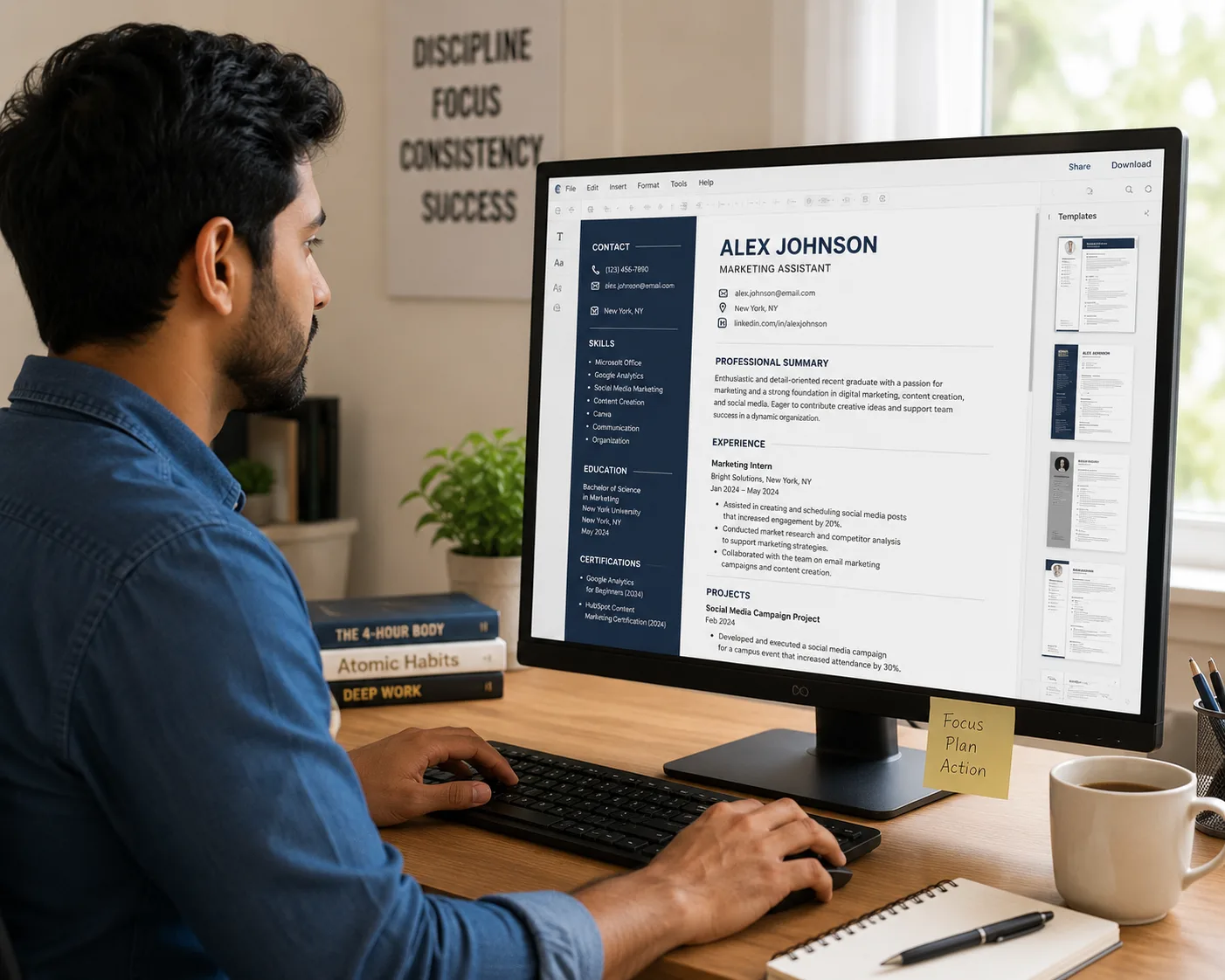
How to Make a Resume on Google Docs: Step-by-Step Guide
According to the Bureau of Labor Statistics (BLS), over 50 million people apply for jobs in the U.S. each year. A significant number of those resumes are created using Google Docs.
According to Google, Google Docs offers 5 free, built-in resume templates through its Template Gallery. According to Indeed, "exporting your resume as a PDF preserves formatting and is recommended for most job applications."
According to CareerBuilder, 75% of resumes are rejected before a human sees them due to formatting issues. Learning how to create a resume properly in Google Docs can significantly improve your chances of getting an interview.
This step-by-step guide walks you through creating a professional resume using Google Docs — from accessing templates to downloading the final version.
“How to Make a Resume on Google Docs: Key Takeaways
- Google Docs has 5 free resume templates
- Access templates through the Template Gallery
- Swiss is the safest, most professional choice
- Customize templates by replacing placeholder text
- Use standard fonts (Arial, Calibri)
- Always download as PDF for job applications
- 75% of resumes are rejected due to formatting issues”
What You'll Learn in This Guide
- How to access Google Docs resume templates
- Which template to choose for your situation
- How to customize your resume step by step
- How to format your resume professionally
- How to download and export your resume
Step 1: Access the Google Docs Template Gallery
According to Google's official support page, accessing the Template Gallery is simple:
Step 1.1: Open your web browser and go to docs.google.com.
Step 1.2: Sign in to your Google account (or create one for free).
Step 1.3: Click the Template Gallery icon at the top-right of the page.
Step 1.4: Scroll down to the Resumes section.
Step 1.5: Browse the available templates.
According to MakeUseOf, "the template gallery offers a variety of professional-looking templates, including those for resumes, cover letters, and more."
Quick Tip: If you don't see the Template Gallery, you may need to click the "More" button or check that you're using the full version of Google Docs (not mobile).
| Step | Action |
|---|---|
| 1.1 | Open docs.google.com |
| 1.2 | Sign in to your Google account |
| 1.3 | Click the Template Gallery icon |
| 1.4 | Scroll to the Resumes section |
| 1.5 | Browse available templates |
Step 2: Choose the Right Resume Template
Google Docs offers 5 built-in resume templates. According to Toptal, "the resume template you choose can significantly impact how your qualifications are perceived by employers."
Template Overview:
| Template | Layout | Best For | ATS-Safe |
|---|---|---|---|
| Swiss | Single-Column | Corporate, tech, finance | ✅ Yes |
| Spearmint | Single-Column | Students, entry-level, healthcare | ✅ Yes |
| Modern Writer | Single-Column | Content creation, marketing | ✅ Yes |
| Serif | Two-Column | Law, academia, traditional | ⚠️ May confuse ATS |
| Coral | Two-Column | Creative roles, design | ⚠️ May confuse ATS |
According to Indeed, "the Swiss template is a safe choice because it uses a standard single-column layout that is compatible with most Applicant Tracking Systems."
Recommendation: If you're unsure which to choose, pick Swiss. It's the safest, most professional option for most job applications.
Step 3: Open Your Chosen Template
Once you've decided which template to use:
Step 3.1: Click on the template thumbnail.
Step 3.2: A new document will open with the template pre-loaded.
Step 3.3: The template will include placeholder text and formatting.
Step 3.4: The document will automatically be saved to your Google Drive.
Pro Tip: Google Docs auto-saves your work. You can close and reopen your document without losing changes.
Step 4: Customize Your Resume
According to Indeed, "replace the placeholder text with your own information."
Step 4.1: Replace Contact Information
Replace the placeholder name, phone number, email, and address with your own.
What to Include:
- Full name
- Phone number
- Professional email address
- City and state
- LinkedIn URL (optional)
- Portfolio URL (if applicable)
Step 4.2: Write a Professional Summary
According to CareerBuilder, "a strong professional summary grabs the recruiter's attention."
Summary Formula:
> [Job Title] with [X] years of experience in [industry]. Proven track record of [key achievement]. Skilled in [key skills] and [key skills].
Example:
> "Marketing professional with 5+ years of experience in digital strategy. Proven track record of increasing brand engagement by 40%. Skilled in social media management, content creation, and SEO."
Step 4.3: Add Work Experience
According to Indeed, "list your work experience in reverse chronological order (most recent first)."
Format:
- Job Title
- Company Name
- Location (City, State)
- Dates (Month Year - Present/Month Year)
- 3-5 bullet points describing your key achievements
Achievement Formula:
> Action Verb + What You Did + Result/Number
Examples:
- "Increased sales by 25% within 6 months"
- "Managed a team of 15 employees"
- "Reduced costs by 10% through process improvement"
Step 4.4: Add Education
Format:
- Degree
- Major (if applicable)
- Institution Name
- Location (City, State)
- Graduation Year
- GPA (if 3.5 or higher)
Step 4.5: Add Skills
According to Jobscan, "ATS systems look for skills keywords to match job descriptions."
Examples:
- Technical skills: Microsoft Office, Google Suite, Programming Languages
- Soft skills: Communication, Leadership, Problem-Solving
- Industry-specific skills: Project Management, Data Analysis, Customer Service
Step 4.6: Add Additional Sections (Optional)
- Certifications
- Volunteer Experience
- Projects
- Awards
- Languages
- Professional Affiliations
According to Indeed, "feel free to adjust sections and add new ones — but keep it professional."
Step 5: Format Your Resume Professionally
According to Business Insider, "do not use tables, columns, images, text boxes, headers or footers. Keep a one column layout, standard fonts, consistent spacing."
Step 5.1: Use Standard Fonts
According to Indeed, "use Arial, Calibri, or Times New Roman — these are the fonts most ATS systems recognize."
Safe Fonts:
- Arial (recommended)
- Calibri
- Times New Roman
- Georgia
Font Size:
- Name: 20-24 pt
- Headings: 14-16 pt
- Body text: 10-12 pt
Step 5.2: Use Consistent Spacing
- Use standard margins (1 inch on all sides)
- Use consistent line spacing (1.15 or 1.5)
- Add space between sections
- Use bullet points for achievements
Step 5.3: Use Standard Section Headings
According to Jobscan, "ATS systems look for standard section headings."
Standard Headings:
- Professional Summary
- Work Experience
- Education
- Skills
- Certifications
Avoid:
- Creative headings
- Uncommon terminology
- All-caps headings
Step 5.4: Proofread Carefully
According to CareerBuilder, "typos are the #1 reason resumes get rejected."
Check For:
- Spelling errors
- Grammar mistakes
- Inconsistent formatting
- Missing contact information
- Incorrect dates
- Outdated information
Pro Tip: Read your resume out loud to catch errors. Ask a friend or family member to review it.
Step 6: Download and Export Your Resume
According to Indeed, "exporting your resume as a PDF preserves formatting and is recommended for most job applications."
Step 6.1: Click File > Download
Step 6.2: Select PDF Document
Step 6.3: The file will download to your computer
Step 6.4: Attach the file to your job application
Export Options:
| Format | When to Use | Why |
|---|---|---|
| Most job applications | Preserves formatting, looks professional | |
| DOCX | When PDF is not accepted | Editable, but may lose formatting |
| Shareable Link | Collaboration and feedback | Easy sharing, real-time updates |
According to Google's official support page, "Google Docs allows you to download in multiple formats including PDF, DOCX, and ODT."
Pro Tip: Always check the job application instructions. Some employers prefer DOCX over PDF.
Bonus: How to Customize Your Resume for Each Job
According to Indeed, "customizing your resume for each job significantly increases your chances of getting an interview."
Step B1: Save a Copy
- Click File > Make a copy
- Rename the file with the job title and company
- Example: "Resume_Marketing_Manager_CompanyName"
Step B2: Review the Job Description
- Identify keywords and requirements
- Note required skills and qualifications
Step B3: Update Your Professional Summary
- Tailor it to the specific role
- Include relevant keywords
Step B4: Highlight Relevant Experience
- Emphasize experience that matches the job
- Reorder bullet points to highlight the most relevant achievements
Step B5: Update Skills
- Include skills mentioned in the job description
- Remove irrelevant skills
Step B6: Save and Export as PDF
- Download the tailored version as PDF
- Submit with your application
Common Mistakes to Avoid
According to Jobscan, "these are the most common mistakes people make when creating resumes in Google Docs."
| Mistake | Why It's a Problem | How to Fix It |
|---|---|---|
| Using two-column layouts | ATS can't parse them correctly | Use Swiss or Spearmint (single-column) |
| Using tables or text boxes | ATS misreads or ignores content | Use standard text formatting instead |
| Using non-standard fonts | ATS may not recognize them | Use Arial, Calibri, or Times New Roman |
| Not using standard section headings | ATS can't identify sections | Use common headings: Experience, Education, Skills |
| Forgetting to download as PDF | DOCX files can lose formatting | Always download and submit as PDF |
| Not customizing for each job | Looks generic and impersonal | Customize your resume for each application |
| Typos and grammar errors | Top reason resumes get rejected | Proofread carefully — use spell check |
Expert Quotes to Remember
“"The entire Template Gallery is free, including all resume templates."”
“"The Swiss template is a safe choice because it uses a standard single-column layout that is compatible with most Applicant Tracking Systems."”
“"Do not use tables, columns, images, text boxes, headers or footers. Keep a one column layout, standard fonts, consistent spacing."”
“"Typos are the #1 reason resumes get rejected."”
“"The template gallery offers a variety of professional-looking templates, including those for resumes, cover letters, and more."”
Sources & References
- Google Docs Official Support — Template Gallery access and instructions
- Indeed — Resume template guides and career advice
- Business Insider — ATS formatting advice
- CareerBuilder — Resume statistics and tips
- Jobscan — ATS and resume parsing research
- MakeUseOf — Google Docs tutorial guides
- Toptal — Professional resume template reviews
Conclusion: Make Your Resume on Google Docs Today
Creating a professional resume on Google Docs is easy and completely free. According to Google, the platform offers 5 free, built-in resume templates. According to Indeed, the Swiss template is the safest choice for most job applications.
Key Takeaways:
- Google Docs has 5 free resume templates
- Access them through the Template Gallery
- Choose Swiss for the safest, most professional option
- Customize by replacing placeholder text with your information
- Use standard fonts: Arial, Calibri, or Times New Roman
- Use standard section headings
- Use bullet points for achievements
- Download as PDF for job applications
- Customize your resume for each job
Action Steps for Today:
1. Open Google Docs and access the Template Gallery
2. Choose the Swiss template (or Spearmint for entry-level)
3. Replace placeholder text with your information
4. Add your work experience with quantified achievements
5. Proofread carefully for errors
6. Download as PDF
7. Build your resume with our ATS CV Maker
How do I make a resume on Google Docs?
Open Google Docs, click the Template Gallery icon, scroll to the Resumes section, choose a template, replace placeholder text with your information, customize sections, and download as PDF. According to Google's official support page, 'the entire Template Gallery is free, including all resume templates.'
Does Google Docs have a free resume template?
Yes, Google Docs offers 5 free resume templates: Swiss, Serif, Coral, Spearmint, and Modern Writer. According to Google Docs official support, 'the entire Template Gallery is free, including all resume templates.' There are no charges or hidden fees.
How do I access resume templates on Google Docs?
Open Google Docs, sign in to your Google account, click the Template Gallery icon at the top-right, scroll down to the Resumes section, and click on any template to open it. According to MakeUseOf, 'the template gallery offers a variety of professional-looking templates.'
Can I create a resume on Google Docs for free?
Yes, you can create a resume on Google Docs completely free. You only need a free Google account. All 5 built-in resume templates are free to use. According to Google's official support page, 'the entire Template Gallery is free, including all resume templates.'
What is the best resume template on Google Docs?
The Swiss template is generally the best overall choice. According to Toptal, 'swiss is perhaps the easiest and cleanest of the resume templates Google Docs offers.' It uses a single-column layout that is ATS-friendly and works for most industries.
About the Author
Ash is a resume expert and career strategist who helps job seekers create professional resumes. With years of experience in resume writing and ATS optimization, Ash has helped thousands of candidates land interviews. Ash's work has been featured in leading career publications and is trusted by job seekers worldwide.
Comments
Loading comments…