Soft Skills to Put on Resume: Top Interpersonal Skills for 2026
What soft skills to put on a resume in 2026? Learn the top interpersonal skills employers want, how to list them, and examples for different roles.
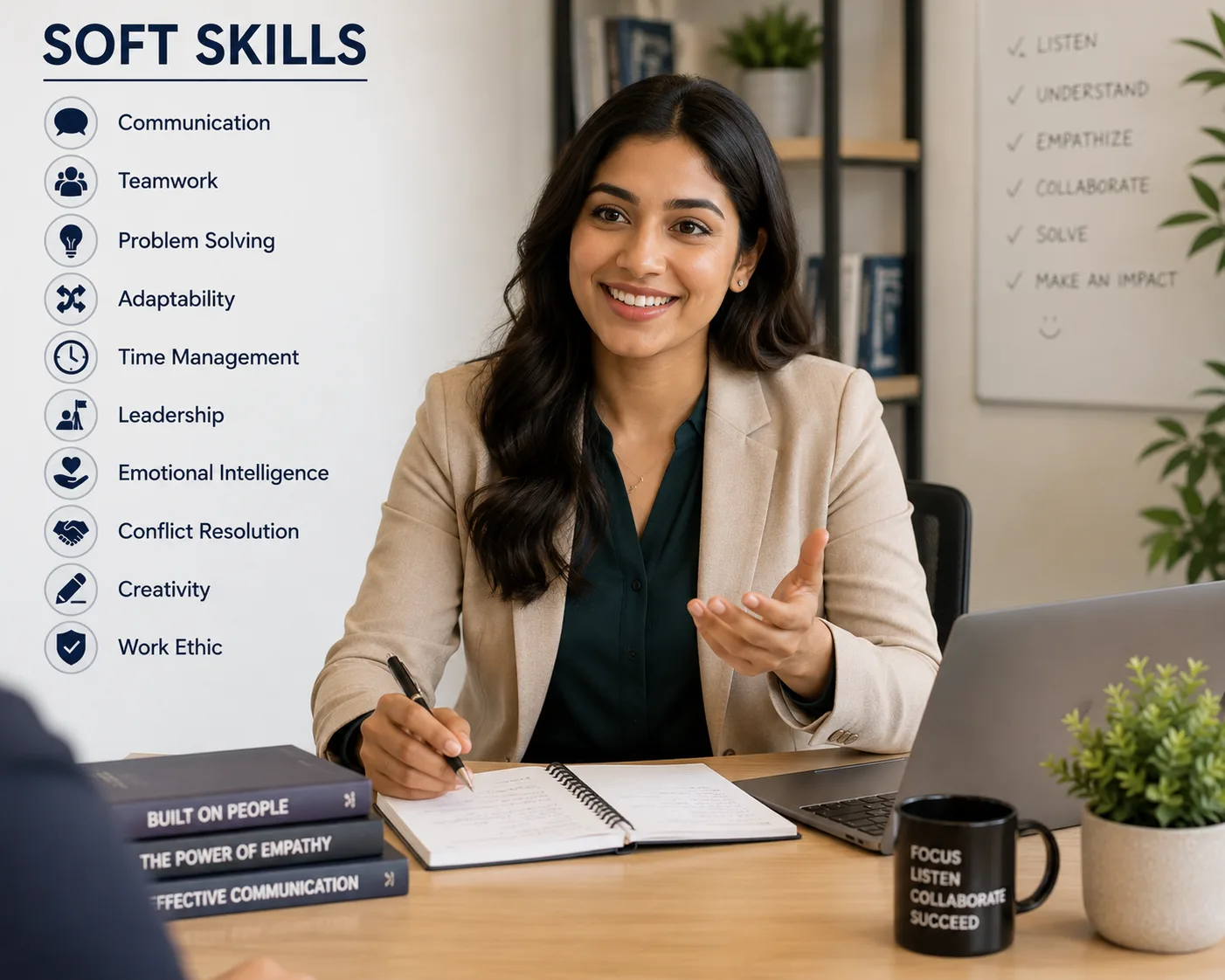
Introduction: The Soft Skills Revolution
According to the National Association of Colleges and Employers (NACE) 2026 Job Outlook Survey, 85% of employers seek teamwork skills on resumes. 82% seek problem-solving skills. 78% seek verbal communication skills. According to Forbes, 41% of recruiters look at the skills section first.
As Colleen Batchelder, Forbes Contributor, explains:
> "Even in the age of AI, most employers are still prioritizing people. They want human skills. They're looking for employees who can communicate confidently, collaborate effectively, and lead with solutions."
According to Rachel Wells, Forbes Senior Contributor:
> "Leadership in 2026 is less about hierarchy and title, and more about influence, connection, relationship-building, and developing others' careers and impact."
This guide covers the most in-demand soft skills for 2026, how to list them on your resume, and how to prove them with real examples.
“Soft Skills — Key Takeaways
85% of employers seek teamwork (NACE 2026)
82% of employers seek problem-solving (NACE 2026)
78% of employers seek verbal communication (NACE 2026)
72% of employers seek written communication (NACE 2026)
4-6 soft skills is the sweet spot for your resume
Prove soft skills with quantifiable achievements
Avoid generic terms like 'good communicator' without context
Soft skills are increasingly valued in the age of AI”
What You'll Learn in This Guide
- What soft skills are and why they matter in 2026
- The most in-demand soft skills (with NACE 2026 data)
- How to choose the right soft skills for your resume
- Where to place soft skills on your resume
- How many soft skills to list (expert recommendations)
- How to prove soft skills with quantifiable achievements
- Before and after examples of soft skills sections
What Are Soft Skills?
Soft skills are interpersonal traits and behavioral attributes that determine how you work with others and handle workplace challenges. According to Indeed, "Employers seek skills like communication, problem-solving and teamwork, which can be valuable for achieving goals and driving results across industries."
According to Sho Dewan, Forbes career expert:
> "Avoid generic terms like 'good communicator' without context. Instead, show how those skills delivered results in your work sample bullets."
The Most In-Demand Soft Skills for 2026 (NACE Data)
According to the NACE 2026 Job Outlook Survey (via Forbes contributor Colleen Batchelder), here are the most in-demand soft skills:
| Soft Skill | % of Employers Seeking It | Why It Matters |
|---|---|---|
| Teamwork | 85% | Collaboration is essential in modern workplaces |
| Problem-Solving | 82% | Critical thinking is the #1 soft skill |
| Communication (Verbal) | 78% | Clear communication prevents errors and drives results |
| Communication (Written) | 72% | Written communication is foundational for remote work |
| Strong Work Ethic | 71% | Reliability and dedication are highly valued |
| Analytical/Quantitative | 70% | Data-driven decision making is essential |
| Initiative | 69% | Self-starters are highly valued |
| Leadership Potential | 68% | Leadership skills are rising in importance |
| Flexibility/Adaptability | 58% | Adaptability is critical in a changing workplace |
How to Choose the Right Soft Skills for Your Resume
According to Sho Dewan, Forbes career expert:
> "Start by listing 6 to 8 core skills that match the job you want, and split them between technical abilities and soft skills."
Step 1: Read the Job Description Carefully
Highlight the soft skills that appear most frequently. If the job description mentions 'communication' three times and 'teamwork' twice, these are clearly important to include.
Step 2: Identify Your Top Soft Skills
From your experience, list 6-10 soft skills that are relevant to the role. Then compare this list to the job description. The skills that appear in both places should be prioritized.
Step 3: Use Exact Keywords from the Job Description
If the job posting says "problem-solving," use "problem-solving," not "critical thinking."
Step 4: Prove Each Soft Skill with a Quantifiable Achievement
According to Sho Dewan:
> "Hiring managers don't just want to know what you were responsible for. They want to know what changed because of your work."
Where to Place Soft Skills on Your Resume
According to Sho Dewan:
> "Place this skills section near the top of your resume so ATS and recruiters see it quickly. Use the same words you see in job descriptions so your resume is more likely to be picked up by keyword filters."
Option 1: Dedicated Skills Section
Blend soft skills with hard skills in a clean, scannable format.
Option 2: Professional Summary
Weave in 3-5 of the most important soft skills.
Option 3: Work Experience Bullet Points
Prove each soft skill with a quantifiable achievement.
Option 4: Avoid Listing Soft Skills in Isolation
According to Sho Dewan, avoid generic terms like 'good communicator' without context. Instead, show how those skills delivered results.
How Many Soft Skills Should You List?
According to Sho Dewan, Forbes career expert:
> "Start by listing 6 to 8 core skills that match the job you want."
The Sweet Spot: 8-12 skills total, including 4-6 hard skills and 4-6 soft skills.
According to NACE 2026, soft skills are increasingly valued—85% of employers seek teamwork and 82% seek problem-solving skills.
Before vs After: Proving Soft Skills
| Before (Weak) | After (Strong) | The Fix (Why It Works) |
|---|---|---|
| "Good communicator" | "Presented quarterly reports to C-suite executives, receiving 100% positive feedback" | Shows communication at an executive level with proof |
| "Team player" | "Led a team of 5 to achieve 35% revenue growth" | Generic term replaced with leadership + result |
| "Problem solver" | "Identified process inefficiency and implemented solution, reducing costs by 25%" | Demonstrates problem-solving with a measurable outcome |
| "Hard worker" | "Collaborated with cross-functional teams to deliver 12 projects on time" | Vague label replaced with specific, measurable achievement |
Soft Skills by Role
| Role | Top Soft Skills |
|---|---|
| Leadership | Communication, Emotional Intelligence, Decision-Making, Delegation, Conflict Resolution |
| Customer Service | Empathy, Active Listening, Patience, Communication, Problem-Solving |
| Technology | Problem-Solving, Communication, Adaptability, Collaboration |
| Healthcare | Empathy, Communication, Teamwork, Adaptability, Active Listening |
| Marketing | Creativity, Communication, Strategic Thinking, Collaboration |
| Teaching | Communication, Patience, Empathy, Adaptability, Problem-Solving |
The AI Paradox: Why Soft Skills Matter More Than Ever
According to Soren Kaplan, Inc. columnist and WSJ bestselling author:
> "The fastest-growing skills in the United States fall into two parallel buckets: technical AI capabilities like prompt engineering and AI implementation, and human-centered skills like executive communications, leadership influence, and cross-functional collaboration. The skills losing value are the ones AI can learn from a dataset."
According to Colleen Batchelder, Forbes Contributor:
> "Even in the age of AI, most employers are still prioritizing people. They want human skills. They're looking for employees who can communicate confidently, collaborate effectively, and lead with solutions."
According to Harvard Business School research, structured cognitive roles declined 13% following ChatGPT's launch, while demand for analytical, creative, and leadership work grew 20%. This means soft skills are not just valuable—they are essential for career survival.
Common Mistakes to Avoid
- Listing soft skills without proof: According to Sho Dewan, avoid generic terms like 'good communicator' without context. Show how those skills delivered results.
- Using generic terms: 'Hard worker,' 'team player,' and 'detail-oriented' mean nothing without evidence.
- Not tailoring soft skills to the job: Different roles require different soft skills. Customer service needs empathy; leadership needs emotional intelligence.
- Listing too many soft skills: Focus on 4-6 key soft skills that are most relevant to the role.
- Ignoring NACE data: According to NACE 2026, teamwork (85%), problem-solving (82%), and communication (78%) are the most in-demand soft skills.
Expert Quotes to Remember
“"Even in the age of AI, most employers are still prioritizing people. They want human skills. They're looking for employees who can communicate confidently, collaborate effectively, and lead with solutions."”
“"Leadership in 2026 is less about hierarchy and title, and more about influence, connection, relationship-building, and developing others' careers and impact."”
“"Avoid generic terms like 'good communicator' without context. Instead, show how those skills delivered results in your work sample bullets."”
“"The fastest-growing skills fall into two parallel buckets: technical AI capabilities and human-centered skills. The skills losing value are the ones AI can learn from a dataset."”
Sources & References
- NACE Job Outlook 2026 – 85% teamwork, 82% problem-solving, 78% communication data
- Forbes / Colleen Batchelder – Soft skills in the age of AI
- Forbes / Rachel Wells – Leadership in 2026
- Forbes / Sho Dewan – Skills section strategy
- Inc. / Soren Kaplan – AI and human-centered skills split
- Harvard Business School – AI and cognitive role research
Conclusion: Build Your Soft Skills Resume Today
Your soft skills are increasingly valuable in the age of AI. According to NACE 2026, 85% of employers seek teamwork skills and 82% seek problem-solving skills.
Key Takeaways:
- Include 4-6 soft skills on your resume
- Prove each soft skill with a quantifiable achievement
- Use exact keywords from the job description
- Place your skills section near the top
- Avoid generic terms like 'good communicator' without context
- Tailor your soft skills to each specific role
Action Steps for Today:
1. Review the job descriptions you are targeting
2. Identify the top 4-6 soft skills they mention
3. Create a dedicated skills section near the top of your resume
4. Add keywords to your professional summary
5. Prove each soft skill with a quantifiable achievement in your experience section
6. Build your skills-first resume with our ATS CV Maker
What are soft skills on a resume?
Soft skills are interpersonal traits and behavioral attributes that determine how you work with others and handle workplace challenges. They include communication, teamwork, problem-solving, emotional intelligence, leadership, and adaptability. According to NACE 2026 data, 85% of employers seek teamwork and 82% seek problem-solving skills.
How many soft skills should I put on my resume?
According to Forbes career expert Sho Dewan, list 6 to 8 core skills that match the job you want. For soft skills specifically, aim for 4-6 interpersonal abilities that are most relevant to the role you are targeting. Include a mix of communication, teamwork, problem-solving, and leadership skills.
What are the most in-demand soft skills for 2026?
According to NACE 2026 data, the most in-demand soft skills are teamwork (85%), problem-solving (82%), verbal communication (78%), written communication (72%), strong work ethic (71%), analytical/quantitative skills (70%), initiative (69%), leadership potential (68%), and flexibility/adaptability (58%).
What is the difference between soft skills and hard skills?
Soft skills are interpersonal traits like communication, teamwork, and emotional intelligence. Hard skills are teachable, measurable abilities like programming, data analysis, or foreign languages. According to NACE 2026 data, employers seek both—85% look for teamwork while 73% seek technical skills.
Where should I put soft skills on my resume?
Place soft skills in three places: a dedicated skills section (blended with hard skills), your professional summary (weaving in 3-5 key skills), and your work experience bullet points (proving each skill with quantifiable achievements). According to Forbes career expert Sho Dewan, avoid listing soft skills in isolation without proof.
About the Author
Ash is a resume expert and career strategist who helps job seekers land their dream roles. With years of experience in resume writing and ATS optimization, Ash has helped thousands of candidates create resumes that get noticed. Ash's work has been featured in leading career publications and is trusted by job seekers worldwide.
Comments
Loading comments…