Chief Information Security Officer Resume: Example & Guide
Chief information security officer resume example and writing guide. Learn what a CISO resume looks like, key skills, job description, and ranking insights.
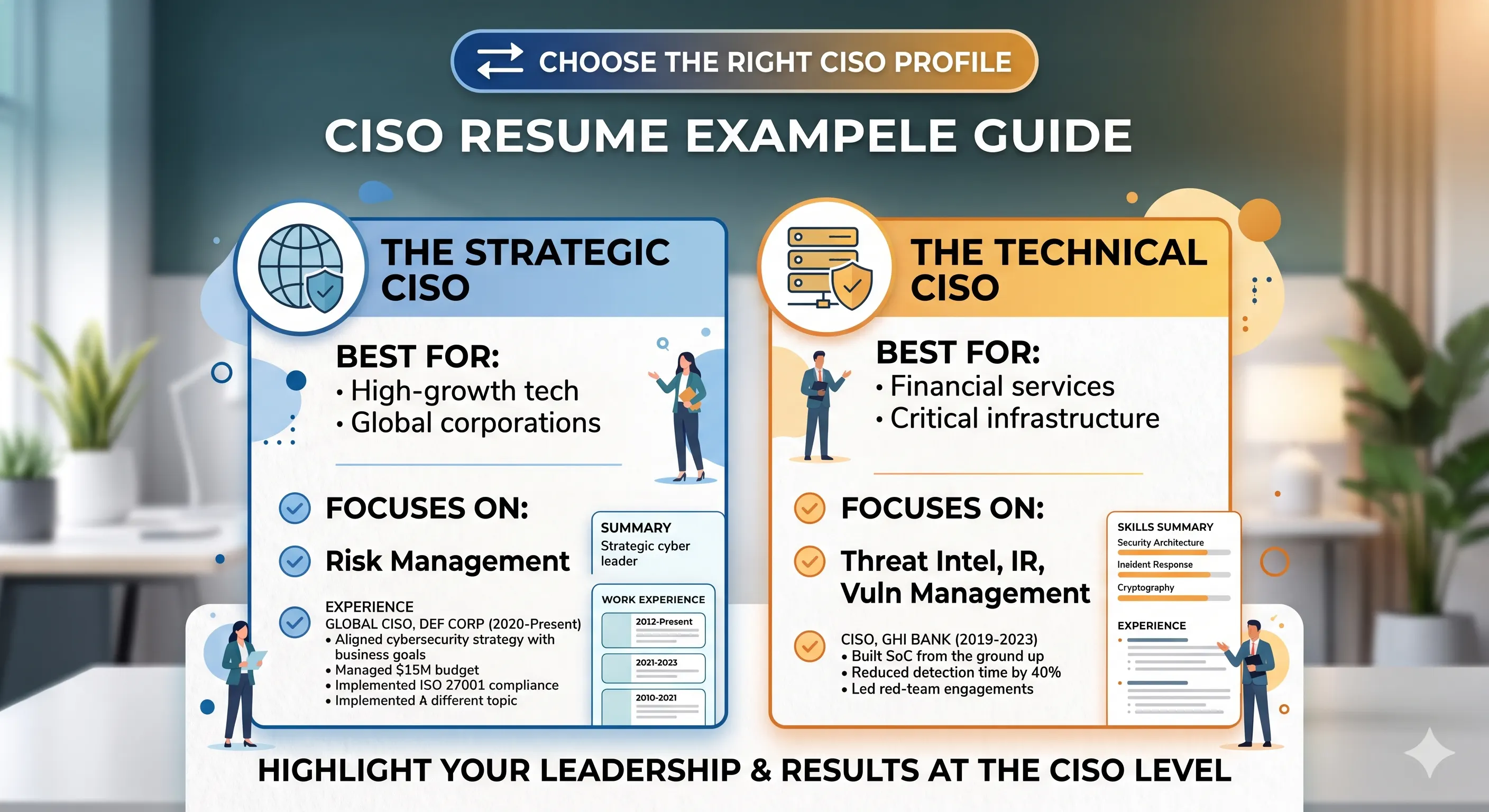
Introduction: What Does a CISO Resume Look Like?
A Chief Information Security Officer (CISO) is not just a senior technologist—they are a business leader responsible for protecting an organization's most critical assets. Consequently, a CISO resume looks very different from a standard IT resume. It prioritizes strategic vision, risk management, and measurable business outcomes over technical minutiae.
This guide provides a complete chief information security officer resume example, breaks down the key skills employers demand, and answers the most common questions about this elite executive role. Whether you are an aspiring CISO or a hiring manager, this resource will clarify exactly what sets an exceptional CISO resume apart.
Who is Higher, CIO or CISO?
One of the most frequent questions about the CISO role is: who is higher, CIO or CISO? Traditionally, the Chief Information Officer (CIO) sits higher in the organizational hierarchy. The CIO oversees the entire IT strategy, infrastructure, and operations, while the CISO is often positioned as a direct report to the CIO, responsible specifically for cybersecurity.
However, the answer is shifting. In many modern, security-mature organizations, the CISO reports directly to the CEO or the Board of Directors. This makes them peers of the CIO rather than subordinates. The reporting structure reflects how seriously the organization views cybersecurity as a business risk, not just a technical function. When crafting your chief information security officer resume, emphasizing board-level reporting and strategic influence signals seniority and executive credibility.
Is CISO a High Position?
Without question, the CISO is a very high-ranking executive position. It is a C-suite role, often sitting alongside the CFO, COO, and CIO. The CISO is directly responsible for protecting an organization's digital assets, intellectual property, and customer data.
The importance of this role cannot be overstated. A single data breach can cost millions in fines, legal fees, and lost customer trust. This level of responsibility places the CISO at the strategic heart of the organization. In large enterprises, the CISO regularly presents to the board, advises on M&A security risks, and influences company-wide policy. Your chief information security officer resume must reflect this seniority through language, metrics, and the scope of responsibilities you describe.
What is the Job Description of a Chief Information Security Officer?
A chief information security officer job description typically outlines a broad and strategic role. The CISO is the executive accountable for an organization's information security strategy, policies, and operations. Core responsibilities include:
- Developing and implementing a comprehensive information security program
- Managing cybersecurity risk and establishing risk tolerance frameworks
- Ensuring regulatory compliance with frameworks like GDPR, HIPAA, and PCI-DSS
- Leading incident response and breach recovery efforts
- Managing security budgets, vendors, and external partnerships
- Reporting security posture and risks to the board and executive leadership
- Building and leading a high-performing security team
- Driving security awareness and culture across the organization
This is not a hands-on technical role. A CISO does not configure firewalls or write code. They provide strategic direction, secure resources, and translate technical risk into business language that the CEO and board can act upon. Your chief information security officer resume should reflect this executive-level focus.
Chief Information Security Officer Resume Example
Below is a realistic chief information security officer resume example. Use this as a template to structure your own executive resume.
Executive Summary
Transformational CISO with 18+ years of experience securing global financial services organizations. Proven track record of reducing cyber risk by 45% while aligning security strategy with business objectives. Expert in regulatory compliance (GDPR, PCI-DSS, HIPAA), incident response, board governance, and security transformation. Trusted advisor to executive leadership and board committees on risk management and emerging threat landscapes.
Core Competencies
- Information Security Strategy
- Risk Management & Compliance
- Incident Response & Recovery
- Security Architecture
- Board & Executive Reporting
- Budget Management ($50M+)
- Team Leadership & Development
- Vendor & Third-Party Risk
Executive Experience
Chief Information Security Officer | Global Financial Partners | 2020–Present
- Led the security transformation of a $12B financial services organization, reducing breach risk by 45% over 3 years.
- Managed a $45M security budget and a team of 120 security professionals across 5 global regions.
- Developed and implemented an enterprise-wide zero-trust architecture, achieving 99.8% threat detection accuracy.
- Reported directly to the CEO and board audit committee, delivering quarterly security posture briefings.
- Successfully navigated 4 major regulatory audits with zero findings and maintained 100% compliance.
Director of Information Security | TechGuard Solutions | 2015–2020
- Built the security program from the ground up, scaling from a single practitioner to a 40-person team.
- Achieved ISO 27001 certification within 18 months, opening new revenue opportunities in regulated markets.
- Reduced incident response time from 48 hours to under 4 hours through automation and process redesign.
- Designed and delivered a security awareness program that reduced phishing susceptibility by 60%.
Board & Advisory Roles
- Advisory Board Member – CyberRisk Alliance (2023–Present)
- Board Observer – SecureTech Ventures (2022–Present)
Education & Certifications
- MBA, Stanford Graduate School of Business
- BS, Computer Science, Carnegie Mellon University
- CISSP (Certified Information Systems Security Professional)
- CISM (Certified Information Security Manager)
- CRISC (Certified in Risk and Information Systems Control)
Essential CISO Resume Skills and Keywords
When submitting your chief information security officer resume, ensure it contains these critical keywords. ATS systems and recruiters actively scan for these terms:
- Information Security Strategy
- Risk Management
- Regulatory Compliance (GDPR, HIPAA, PCI-DSS)
- Incident Response
- Board Reporting
- Security Architecture
- Zero Trust
- Cloud Security (AWS, Azure, GCP)
- Data Privacy
- Third-Party Risk Management
- Business Continuity
- Disaster Recovery
- Security Budget Management
- Executive Leadership
- Security Awareness
How to Write a Chief Information Security Officer Resume
Writing an effective CISO resume requires a shift in mindset. This is not a technical resume—it is an executive leadership document. Follow these principles:
1. Start with a Compelling Executive Summary
Your summary is the first thing a recruiter or board member reads. It must immediately convey your seniority, industry experience, and the value you bring. Use the phrase 'chief information security officer resume' naturally and quantify your impact where possible.
2. Prioritize Business Language Over Technical Jargon
While a technical background is essential, your CISO resume must speak to business leaders. Focus on risk reduction, cost savings, regulatory compliance, and business enablement. Avoid terms like 'configured firewalls' or 'deployed SIEM tools.' Instead, say 'led security transformation achieving 45% risk reduction.'
3. Quantify Everything
Every significant achievement should include a metric. Quantified results build credibility and demonstrate measurable impact. Examples: 'Reduced breach risk by 40%,' 'Managed $50M budget,' 'Achieved 99.8% threat detection,' 'Reduced incident response from 48 to 4 hours.'
4. Highlight Board and Executive Interactions
Board exposure is a strong indicator of seniority. If you have presented to boards, led audit committee discussions, or served in advisory capacities, make this explicit. It signals that you operate at the highest levels of the organization.
5. Showcase Certifications and Education
CISSP, CISM, and CRISC are the gold standards for a CISO. An MBA or relevant graduate degree is highly valued, especially for roles in finance, healthcare, or technology. List these prominently in a dedicated section.
Common Mistakes to Avoid on a CISO Resume
- Focusing on technical tasks rather than strategic outcomes
- Failing to quantify achievements with metrics
- Using overly generic language without industry context
- Neglecting to highlight board or executive-level engagement
- Listing outdated or irrelevant certifications
- Writing a resume that exceeds 2 pages
Final Thoughts: Crafting Your Path to the C-Suite
A chief information security officer resume is a document of influence, not just experience. It must demonstrate that you are a strategic leader capable of protecting the organization while enabling business growth. By following the structure and principles outlined in this guide, you can create a resume that resonates with both hiring committees and board members.
Remember: the CISO role is one of the highest positions in the corporate hierarchy. Your resume must reflect that stature. Lead with strategy, quantify your impact, and communicate your ability to translate complex security risks into clear business decisions. Your next executive role awaits.
What does a CISO resume look like?
A CISO resume is an executive-level document that prioritizes strategic leadership, risk management, and measurable security outcomes over technical minutiae. It opens with a powerful executive summary, followed by core competencies, executive experience with quantified achievements, board or advisory roles, education, and professional certifications. It is typically 2 pages, focuses on business alignment, and uses metrics like 'reduced breach risk by 40%' and 'managed $50M security budget.'
Who is higher, CIO or CISO?
Traditionally, the CIO (Chief Information Officer) is higher in the organizational hierarchy. The CIO oversees the entire IT strategy, infrastructure, and operations, while the CISO is often a direct report to the CIO. However, in larger, security-mature organizations, the CISO may report directly to the CEO or Board of Directors, making them peers rather than subordinates. The reporting structure depends on how seriously the company treats cybersecurity as a business risk.
What is the job description of a chief information security officer?
A CISO is the executive responsible for an organization's information security strategy, policies, and operations. Key responsibilities include developing and implementing security programs, managing cybersecurity risk, ensuring regulatory compliance (e.g., GDPR, HIPAA), leading incident response, managing security budgets and vendors, and reporting security posture to the board. The role is a blend of technical understanding, business strategy, risk management, and executive communication.
Is CISO a high position?
Yes, the CISO is a very high-ranking executive position. It is a C-suite role, often sitting alongside the CFO, CIO, and COO. The CISO is directly responsible for protecting the organization's most valuable digital assets and reputation. A data breach can cost millions and destroy customer trust, making the CISO a critical strategic partner. In large enterprises, the CISO reports to the CEO or Board, highlighting the position's seniority and strategic importance.
### 📄 Resume Format Guide
- Chronological vs Functional Resume: Which Format is Best?
- Resume Format Rules: Complete Guide for 2026
Comments
Loading comments…