Chronological vs Functional Resume: Key Differences
What is the difference between chronological and functional resumes? Learn which format suits your career stage, with examples, pros, cons, and ATS tips.
Introduction: Chronological vs Functional Resume – Which One Gets You Hired?
If you have ever asked, 'What is the difference between chronological and functional resume formats?' you are not alone. This is one of the most common questions job seekers ask—and for good reason. Choosing the wrong resume format can mean the difference between landing an interview and being silently filtered out by an Applicant Tracking System (ATS).
In this comprehensive guide, we will break down exactly what each format is, when to use them, and—most importantly—which one will give you the best chance of success in the 2026 job market. By the end, you will have a clear decision framework and be ready to craft a resume that gets noticed.
What is a Chronological Resume? (The Traditional Favorite)
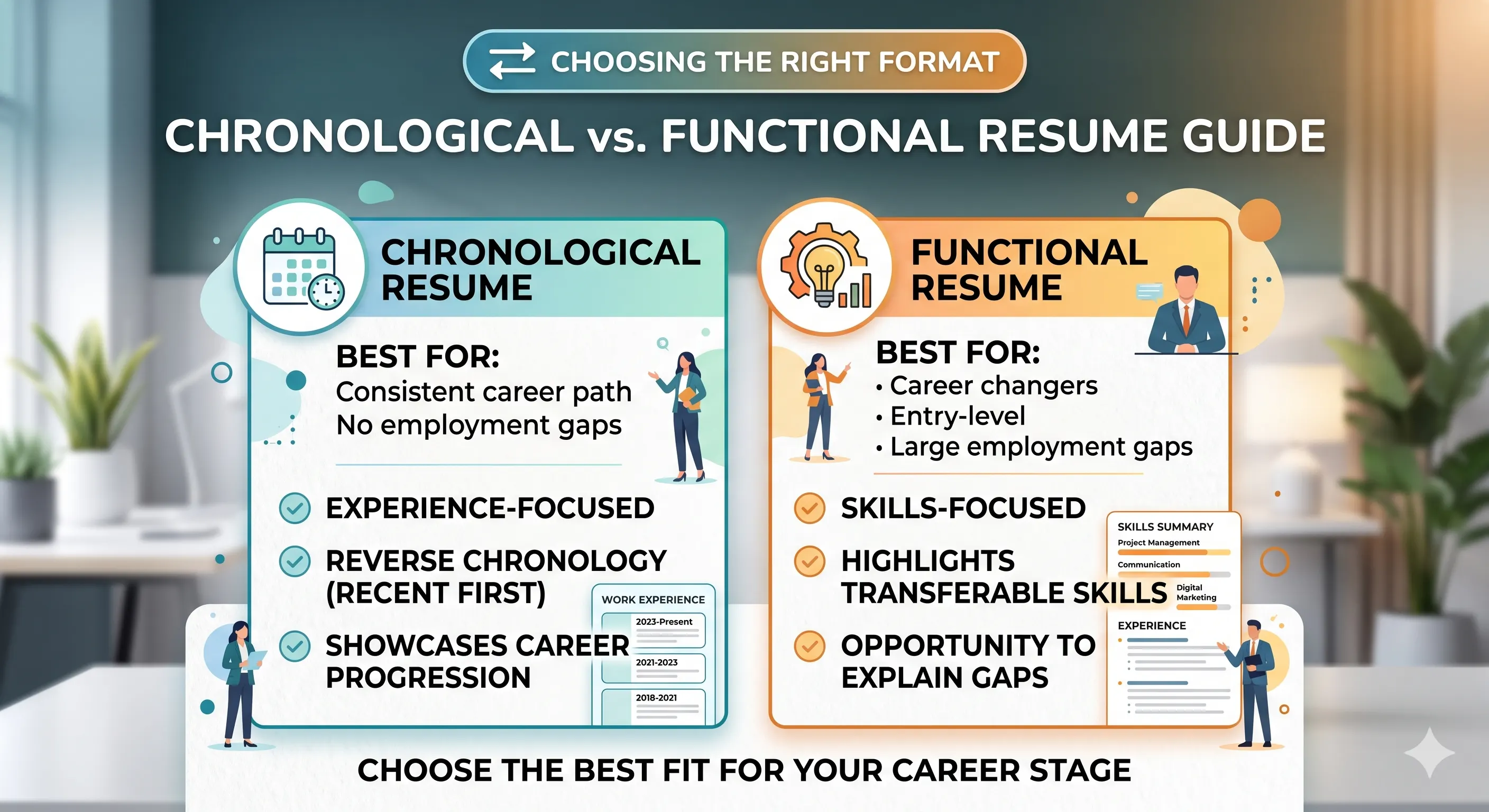
The chronological resume is the most common and recognizable resume format. It lists your work history in reverse chronological order, meaning your most recent job appears first, followed by previous positions. This format focuses heavily on your career progression, job titles, and the companies you have worked for.
Structure of a Chronological Resume
- Contact Information
- Professional Summary (brief overview of your experience)
- Work Experience (reverse chronological order – most recent first)
- Education
- Skills (often placed near the bottom)
Example of a chronological work experience entry:
Operations Manager | ABC Logistics | 2022–Present
- Led a team of 45 warehouse staff, increasing productivity by 25% year-over-year.
- Implemented a new WMS system that reduced order errors by 40%.
Pros of a Chronological Resume
- Highly preferred by recruiters and HR professionals
- ATS-friendly (easy for software to parse)
- Clearly shows career growth and progression
- Familiar and expected format—no confusion
- Highlights consistent employment history
Cons of a Chronological Resume
- Exposes employment gaps
- Does not hide frequent job changes or short stints
- Less effective for career changers (lack of relevant titles)
- Emphasizes job titles over actual skills
What is a Functional Resume? (The Skills-Based Alternative)
So, what does a functional resume mean? Simply put, a functional resume is a skills-based format that organizes your qualifications by functional skill categories rather than by job timeline. Instead of leading with a list of employers and dates, it leads with a robust 'Core Competencies' or 'Professional Skills' section that highlights what you can do.
Structure of a Functional Resume
- Contact Information
- Professional Summary
- Core Competencies / Skills Summary (3-5 categories with bulleted achievements)
- Professional Experience (brief list of employers with minimal details)
- Education
Example of a functional skills section:
Core Competencies
Project Management
- Successfully managed cross-functional teams on 15+ projects, delivering all on time and under budget.
Budget & Financial Oversight
- Managed departmental budgets exceeding $5M and identified cost savings of 12% annually.
Team Leadership
- Mentored and trained 30+ junior staff across three departments.
Pros of a Functional Resume
- De-emphasizes employment gaps
- Great for career changers (can highlight transferable skills)
- Excellent for military-to-civilian transitions
- Emphasizes what you can do—not just where you worked
- Helps hide a disjointed work history
Cons of a Functional Resume
- Viewed with suspicion by many recruiters (appears deceptive)
- Poor ATS compatibility (software struggles to find standard chronological data)
- Harder to assess career progression
- Often considered 'non-traditional' and risky
- Can raise more questions than it answers
Head-to-Head: Key Differences at a Glance
To clearly answer 'what is the main difference between the chronological and functional resume types?' here is a direct comparison:
- Primary Focus: Chronological = Career Timeline / Employers; Functional = Skills & Abilities
- Structure: Chronological = Reverse-chronological job list; Functional = Skill categories followed by brief job list
- Best For: Chronological = Steady career progression; Functional = Career changers or gap-fillers
- ATS Compatibility: Chronological = High; Functional = Low to Medium
- Recruiter Preference: Chronological = Highly preferred; Functional = Often met with skepticism
- Emphasis: Chronological = 'Where and when I worked'; Functional = 'What I can do for you'
When to Use a Chronological Resume (The Safest Bet)
In 2026, the chronological resume remains the gold standard. You should choose this format if:
- You have a solid, continuous work history with no significant gaps
- Your career progression shows clear advancement (promotions, increased responsibilities)
- You are applying to corporate, government, or traditional industry roles (finance, law, education, healthcare)
- You want to pass ATS screenings with minimal friction
- Your most recent job titles directly align with the role you are targeting
Simply put, if you have nothing to hide, a chronological resume is almost always the right choice.
When to Use a Functional Resume (The Strategic Exemption)
Despite its risks, the functional resume is a strategic lifesaver in specific situations. You should choose this format if:
- You are changing industries and your previous job titles are irrelevant (e.g., moving from retail management to nonprofit program coordination)
- You have significant employment gaps (e.g., raising children, caregiving, extended illness, or layoffs)
- You are a military veteran transitioning to a civilian role
- You have held multiple short-term contracts (under 6 months) and want to de-emphasize that pattern
- You are a recent graduate with minimal work experience but strong internships or volunteer work
Warning: If you choose a functional resume, you MUST still include a brief 'Work History' section with company names and dates to maintain some level of transparency. Omitting it entirely is a red flag.
What About the Hybrid Resume? (The Modern Best of Both Worlds)
If you are still asking 'which type of CV is better?' the answer for most people in 2026 is actually neither—it is the hybrid (combination) resume.
A hybrid resume opens with a powerful 'Skills Summary' or 'Core Competencies' section (like a functional resume) to immediately showcase your top abilities. Then, it transitions into a full chronological work history (like a chronological resume). This gives you the ATS-friendly structure recruiters demand while still allowing you to highlight your transferable skills upfront.
Structure of a Hybrid Resume:
- Contact Information
- Professional Summary
- Core Competencies / Key Skills (3-5 bullets)
- Professional Experience (reverse chronological with full details)
- Education
This format is rapidly becoming the most recommended by career coaches because it solves the 'functional vs chronological' debate entirely. You get the best of both worlds without the risk of either extreme.
Which Type of CV is Better? The Verdict for 2026
If you are looking for a single definitive answer, here it is: The chronological format is better 80% of the time.
Recruiters are creatures of habit. They expect to see your work history in reverse chronological order. When they pick up a functional resume, their immediate thought is often: 'What are they hiding?' That suspicion can cost you the interview.
However, if you fall into the career changer, military transition, or significant gap category, a functional or hybrid format is not just acceptable—it is strategic. It allows you to frame your narrative around what you can do rather than what your job titles used to be.
Here is the safest rule of thumb:
- Steady career in the same field? → Go Chronological.
- Changing fields or hiding gaps? → Go Hybrid (lead with skills, still show dates).
- Extreme gaps or highly disjointed history? → Go Functional (but proceed with caution and be transparent).
How to Choose: A Simple Decision Framework
Still unsure? Answer these 5 questions honestly. Your answers will tell you exactly which format to choose.
1. Do you have 5+ years of continuous, relevant experience in your target field?
- Yes → Chronological or Hybrid
- No → Functional or Hybrid
2. Have you had 3 or more jobs in the last 5 years?
- No (I stayed put) → Chronological
- Yes → Functional or Hybrid
3. Are you applying to a traditional corporate role (e.g., banking, law, government)?
- Yes → Chronological (absolutely no functional)
- No → Hybrid or Functional
4. Is the job description asking for specific skills rather than specific job titles?
- Yes → Functional or Hybrid
- No → Chronological
5. Do you have a career gap longer than 12 months?
- Yes → Functional or Hybrid
- No → Chronological
Common Mistakes to Avoid When Choosing Your Resume Format
Even if you pick the right format, these common mistakes can ruin your chances:
1. Using a functional resume without a brief work history section.
Always include a 'Professional Experience' or 'Employment History' section with company names, locations, and dates. Even if you list only 1-2 bullet points per job, you must provide a timeline.
2. Mixing formats inconsistently.
Do not write a functional resume but then bury your skills in the middle. Structure is everything. If you choose functional, lead with skills. If you choose chronological, lead with work history.
3. Ignoring ATS keywords.
Regardless of format, you must include the exact keywords from the job description. The format does not matter if you fail the keyword test.
4. Using a functional resume for a government or federal job.
US federal resumes require a strict chronological format. A functional resume will be automatically rejected.
5. Not tailoring the format to the specific job.
You can have a hybrid base resume, but you should still adjust the 'Core Competencies' section for every single application to match the job description.
Tips for Making Any Resume Format Work for You
Regardless of which format you choose, these universal tips will strengthen your application:
1. Quantify everything.
Instead of saying 'Managed a team,' say 'Managed a team of 25 and increased productivity by 18%.' Metrics translate across all formats.
2. Use a strong professional summary.
Your summary is the first thing a recruiter reads. Make it punchy, include your top 3 skills, and clearly state your target role.
3. Keep it to 1-2 pages.
For most roles, a one-page resume is ideal. Two pages are acceptable for executives or academics. Never go beyond two pages.
4. Save as a PDF (unless instructed otherwise).
PDFs preserve your formatting across devices. However, if the job posting explicitly asks for a Word document, follow their instructions.
5. Test your resume with an ATS scanner.
Use free tools like Jobscan or SkillSyncer to check if your chosen format and keywords will pass the automated screening.
Final Thoughts: Make the Right Choice Today
So, 'is a functional resume better?' The honest answer is: rarely. For the vast majority of job seekers in 2026, the chronological or hybrid resume will serve you much better. Functional resumes are a niche tool for specific scenarios—they are not the default.
To summarize our deep dive:
- Chronological: Best for steady careers, ATS-friendly, recruiter-preferred.
- Functional: Best for career changers, gap-fillers, and veterans—but use with caution.
- Hybrid: The safest compromise—leads with skills but shows a full work history.
Take 15 minutes right now to evaluate your career story. Look at your last 10 years. Are there gaps? Are you changing fields? Are your titles impressive or irrelevant? Answer those questions, and you will know exactly which format to choose.
Stop overthinking it. Pick your format, write your resume, and get it out into the world. Your next job is waiting.
What is the main difference between the chronological and functional resume types?
The main difference lies in the focus and structure. A chronological resume lists your work history in reverse chronological order (most recent job first) and emphasizes career progression, job titles, and employers. A functional resume is skills-based—it organizes your qualifications by functional skill categories (e.g., 'Project Management,' 'Leadership') rather than by timeline, de-emphasizing job titles and employment dates.
What does a functional resume mean?
A functional resume is a resume format that groups your qualifications and achievements by skill category rather than by job timeline. Instead of listing 'Company A – 2018-2020' followed by bullet points, it opens with a 'Core Competencies' or 'Professional Skills' section that highlights your abilities across 3-5 key areas, such as 'Strategic Planning,' 'Budget Management,' or 'Team Leadership.' It is often used by career changers, people with employment gaps, or those with frequent job changes.
Which type of CV is better?
For 2026, the chronological format is generally better and more widely preferred by recruiters and Applicant Tracking Systems (ATS) because it is the standard they expect. It provides a clear, easy-to-follow career narrative. However, 'better' depends entirely on your situation. If you have a strong, linear career progression with no major gaps, choose chronological. If you are changing industries, have significant gaps, or have held multiple short-term roles, a functional or hybrid format may serve you better.
Is a functional resume better?
No, a functional resume is not inherently 'better.' In fact, it carries significant risks. Many recruiters view functional resumes with suspicion because they appear to be hiding something (like gaps or lack of experience). ATS software also struggles to parse functional formats because they lack standard chronological headers. However, a functional resume is a strategic lifesaver for career changers, military veterans entering civilian roles, or professionals re-entering the workforce after a long break. For most people, a hybrid (combination) resume is the safest compromise.
What is a hybrid resume?
A hybrid resume (also called a combination resume) merges the best of both formats. It opens with a strong 'Professional Summary' and a 'Core Competencies' section (like a functional resume) to highlight your top skills upfront. Then, it follows with a detailed 'Work Experience' section in reverse-chronological order (like a chronological resume). This gives you the ATS-compatibility of a chronological format while still allowing you to showcase your most relevant skills at the top.
Conclusion: Stop Guessing, Start Writing
Understanding the difference between chronological and functional resumes is the first step toward creating a document that actually gets you interviews. By now, you should be able to confidently answer: 'What is the main difference between the chronological and functional resume types?' and more importantly, you should know exactly which one fits your personal career story. Remember—a resume is just a tool. The best format is the one that tells your story clearly, honestly, and in a way that resonates with the hiring manager on the other side. Choose wisely, write confidently, and go get that interview.
Comments
Loading comments…