Great Skills and Abilities for Resume: The Ultimate 2026 Guide
Discover the best skills and abilities for your resume in 2026. Learn which hard and soft skills employers want, with data-backed insights and expert advice.
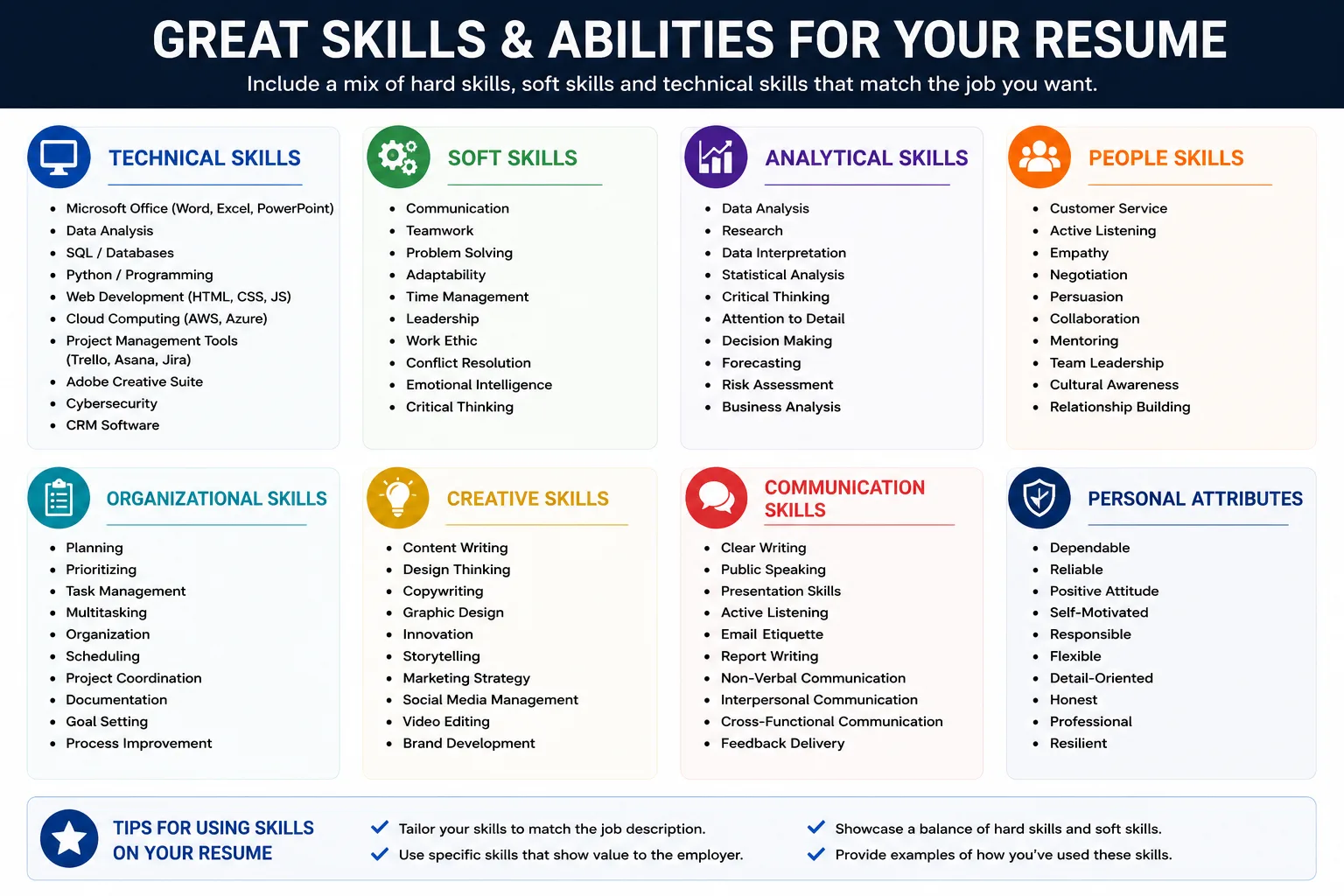
Introduction: The 30-Second Reality
You have 30 seconds. That is how long most recruiters spend deciding whether your resume is worth a second look. In that half-minute, they are scanning for one thing above all else: skills.
According to a survey of over 1,000 HR professionals, 63.7% go straight to the skills section when first evaluating a resume. And here is the kicker—98.7% of recruiters say they value quantifiable achievements, but you cannot quantify what you do not list. The skills you choose to highlight can make or break your chances.
According to Forbes Senior Contributor Rachel Wells, "Hiring managers are no longer asking, 'Where did you work?' or 'What college did you graduate from?' They want to know, 'What results can you deliver?'"
This guide covers the best skills and abilities for your resume in 2026, backed by data from NACE, Forbes, Indeed, and real recruiter surveys. You will learn which skills employers actually want, how to list them, and why the right mix of hard and soft skills lands interviews.
“Resume Skills — Key Takeaways
63.7% of HR professionals go straight to the skills section first
76% of companies use ATS to filter candidates by skills
41% of recruiters look at the skills section first
90% of employers seek problem-solving skills (NACE)
80% of employers seek teamwork skills (NACE)
73% of employers value adaptability and resilience
89% of hiring managers consider soft skills equally as important as hard skills
98.8% of recruiters value clean, consistent formatting”
What You'll Learn in This Guide
- The difference between hard skills and soft skills
- What employers are actually looking for (with data)
- The best hard skills for your resume in 2026
- The best soft skills for your resume in 2026
- How to list skills on your resume (with examples)
- Common mistakes to avoid
- Sample skills sections by role
The Two Types of Resume Skills You Need to Know
Before diving into the list, it is critical to understand the difference between the two main categories of skills. Employers look for both, and your resume needs a healthy mix.
Hard Skills (Technical Abilities)
Hard skills are teachable, measurable abilities you acquire through education, training, or hands-on experience. They are the specific, tangible competencies that qualify you for a role.
Examples:
- Programming languages (Python, Java, SQL)
- Data analysis and visualization (Tableau, Power BI)
- Foreign languages
- Project management (Agile, Scrum, Waterfall)
- Cloud computing (AWS, Azure, GCP)
- Cybersecurity
- Graphic design (Adobe Creative Suite)
- Financial modeling
Soft Skills (Interpersonal Abilities)
Soft skills relate to how you work with others, manage responsibilities, and navigate workplace challenges. According to a Zety report, 80% of the top 20 skills listed on resumes are now soft skills. Employers value these because they determine how well you will fit into a team and adapt to change.
Examples:
- Communication (written and verbal)
- Teamwork and collaboration
- Problem-solving
- Adaptability
- Leadership
- Emotional intelligence
- Time management
- Active listening
The Balance That Wins
According to LinkedIn's Workplace Learning Report, 89% of hiring managers consider soft skills equally as important as hard skills. However, 73% of resumes are rejected due to missing key technical competencies. The challenge lies in striking the right balance.
> Resume Tip: Hard skills help you qualify for a role. Soft skills help you perform well and grow professionally. You need both.
What Employers Are Actually Looking For (The Data)
The NACE Survey: Problem-Solving and Teamwork Lead the Pack
According to the National Association of Colleges and Employers (NACE) Job Outlook 2025 survey, which gathered responses from 237 employers:
- Nearly 90% of employers seek evidence of problem-solving skills
- Nearly 80% seek candidates with strong teamwork skills
- At least 70% value written communication skills, initiative, strong work ethic, and technical skills
- More than two-thirds seek verbal communication skills, flexibility/adaptability, and analytical/quantitative skills
These are not just nice-to-haves. They are the baseline.
The Forbes/WEF Core Skills (2025-2026)
The World Economic Forum's Future of Jobs report, cited by Forbes, breaks down the core skills U.S. employers demand.
| Skill | % of Employers Seeking It |
|---|---|
| Analytical thinking | 75% |
| Resilience, flexibility, agility | 73% |
| Leadership and social influence | 66% |
| Creative thinking | 63% |
| Motivation and self-awareness | 56% |
| Empathy and active listening | 56% |
| Curiosity and lifelong learning | 54% |
| Technological literacy | 52% |
| AI and big data | 51% |
| Dependability and attention to detail | 42% |
As Rachel Wells writes: "Analytical thinking still takes precedence as the most essential skill for professionals to develop."
The HR Professional Survey (2026)
Jobseeker's survey of over 1,000 HR professionals revealed additional insights:
- 64.8% rated Communication as the most important soft skill
- 57.7% chose Problem-solving as a top skill
- 57.1% highlighted Teamwork as essential
The Best Hard Skills for Your Resume in 2026
1. AI and Big Data
AI will disrupt an estimated 92 million jobs globally, but it will also create 78 million new roles. Employers are scrambling for workers who understand AI, machine learning, and data analytics.
Keywords to Use:
- Artificial Intelligence (AI)
- Machine Learning (ML)
- Data Analysis
- Big Data
- Predictive Analytics
- Natural Language Processing (NLP)
- AI Implementation and Strategy
2. Cloud Computing and Cybersecurity
Cloud and cybersecurity skills are in critical shortage. These are high-paying, high-demand areas.
Keywords to Use:
- AWS / Azure / GCP
- Cloud Migration
- Cybersecurity
- Network Security
- Information Security
- Zero Trust Architecture
- Identity and Access Management (IAM)
3. Technical and Digital Literacy
Industry-specific technical skills (51%) and digital skills (50%) are set to be the most in-demand for 2026. Technological literacy is now a core requirement across nearly all industries.
Keywords to Use:
- [Specific software relevant to your field]
- Database Management
- Programming (Python, SQL, Java)
- Data Visualization (Tableau, Power BI)
- Microsoft Office Suite / Google Workspace
- CRM (Salesforce, HubSpot)
4. Analytical and Critical Thinking
Analytical thinking is the #1 most in-demand skill, with 75% of employers seeking it.
Keywords to Use:
- Data Analysis
- Critical Thinking
- Financial Analysis
- Market Research
- Problem-Solving
- Data Interpretation
- Quantitative Analysis
The Best Soft Skills for Your Resume in 2026
1. Communication
Communication is the most important soft skill, rated by 64.8% of HR professionals. According to Indeed, communication skills include writing, speaking, observing, and empathizing.
Keywords to Use:
- Written Communication
- Verbal Communication
- Public Speaking
- Active Listening
- Stakeholder Engagement
- Presentation Skills
- Persuasion and Negotiation
2. Problem-Solving
Nearly 90% of employers look for problem-solving abilities on resumes. This skill demonstrates your ability to analyze situations, think logically, and develop creative solutions.
Keywords to Use:
- Problem-Solving
- Critical Thinking
- Decision-Making
- Strategic Thinking
- Troubleshooting
- Root Cause Analysis
- Conflict Resolution
3. Teamwork and Collaboration
Nearly 80% of employers seek strong teamwork skills. The ability to collaborate across teams and departments is foundational to creating an efficient workplace.
Keywords to Use:
- Teamwork
- Collaboration
- Cross-Functional Collaboration
- Interpersonal Skills
- Relationship Building
- Cooperation
- Partnership Development
4. Adaptability and Resilience
Resilience, flexibility, and agility are valued by 73% of employers. With rapid technological change, employers need workers who can adapt quickly.
Keywords to Use:
- Adaptability
- Flexibility
- Resilience
- Change Management
- Agility
- Continuous Learning
- Open-Mindedness
5. Leadership and Emotional Intelligence
Leadership skills are rising in importance, with 66% of employers seeking them. Empathy and active listening are also critical, valued by 56% of employers.
Keywords to Use:
- Leadership
- Emotional Intelligence (EQ)
- Empathy
- Mentoring
- Coaching
- Team Development
- Influence
- Conflict Resolution
How to List Skills on Your Resume
Where to Place Your Skills
| Location | Why It Works |
|---|---|
| Dedicated Skills Section | 41% of recruiters look at the skills section first. Include 8-12 relevant skills in a clean, scannable format. |
| Professional Summary | 60.7% of recruiters expect summaries to highlight skills and achievements. |
| Work Experience Bullets | Back up each skill with quantifiable achievements. Example: 'Managed a team of 10 (leadership) and increased sales by 30% (analytical thinking).' |
| Certifications Section | For technical skills like cloud computing, cybersecurity, or project management. |
Formatting Tips (Backed by Data)
- 98.8% of recruiters value clean, consistent formatting
- 80.1% prefer bullet points over paragraphs
- 76.8% prefer resumes submitted as PDFs
- 82.1% say 1-2 pages is the ideal resume length
The ATS Factor
76% of companies use Applicant Tracking Systems (ATS) to filter resumes by skills before a human even sees them. This means:
1. You must include keywords from the job description
2. You need both acronyms and full forms (e.g., "CRM (Customer Relationship Management)")
3. Your skills section must be machine-readable (no tables or columns)
Sample Resume Skills Section (By Role)
For Corporate / Business Roles
- Strategic Planning
- Financial Analysis
- Project Management (Agile, Scrum)
- Stakeholder Management
- Data Analysis (Excel, SQL, Tableau)
- Leadership and Team Development
- Written and Verbal Communication
- Problem-Solving and Critical Thinking
For Technology / IT Roles
- Programming (Python, Java, C++)
- Cloud Computing (AWS, Azure)
- Cybersecurity
- Database Management (SQL, MongoDB)
- DevOps (CI/CD, Docker, Kubernetes)
- Artificial Intelligence / Machine Learning
- Technical Support and Troubleshooting
- Agile / Scrum Methodology
For Creative / Design Roles
- Graphic Design (Adobe Creative Suite)
- User Experience (UX) Design
- Content Creation
- Video Editing
- Brand Strategy
- Storytelling
- Creative Direction
- Project Management
For Entry-Level / First Job
- Communication (Written and Verbal)
- Teamwork and Collaboration
- Adaptability
- Problem-Solving
- Time Management
- Computer Literacy (Microsoft Office, Google Workspace)
- Customer Service
- Attention to Detail
Common Mistakes to Avoid
- Listing Generic, Unproven Skills: 'Hard worker' and 'team player' mean nothing without evidence. According to Forbes, a weak resume offers vague skills, but a strong one proves how those skills impacted results.
- Missing ATS Keywords: Without relevant keywords, your resume gets filtered out before a human sees it. Always customize your skills section for each job application.
- Listing Too Many or Too Few Skills: Most resumes list between 6-20 skills, with the median being 8.81. Focus on quality over quantity.
- Hiding Your Skills: Don't bury your skills at the bottom of your resume. According to Forbes contributor Rachel Wells, your skills section should be towards the top, before your employment history.
- Forgetting to Quantify: Every skill should be backed by a measurable achievement. 'Problem-solving' is weak. 'Solved a critical system outage, reducing downtime by 40%' is strong.
Expert Quotes to Remember
“"Hiring managers are no longer asking, 'Where did you work?' or 'What college did you graduate from?' They want to know, 'What results can you deliver?'"”
“"Analytical thinking still takes precedence as the most essential skill for professionals to develop."”
“"Leadership skills rank very highly in the top 10 skills on the rise and in high demand."”
“"Nearly 90% of employers are seeking evidence of a student's ability to solve problems."”
“"64.8% of HR professionals rate communication as the most important soft skill."”
Sources & References
- NACE Job Outlook 2025 Survey – Problem-solving (90%), teamwork (80%), communication, work ethic, technical skills
- Forbes / Rachel Wells – 20 skills in high demand (analytical thinking 75%, resilience 73%, leadership 66%)
- Forbes / Rachel Wells – Entrepreneurial, leadership, and communication skills
- Jobseeker HR Survey 2026 – Survey of 1,000+ HR professionals
- Indeed – 10 best skills with examples
- Zety – Resume skills report, soft skills vs hard skills
- World Economic Forum – Future of Jobs Report 2025
- LinkedIn – Workplace Learning Report
Conclusion: Build Your Skills-First Resume
The job market in 2026 is skills-first. According to Forbes contributor Rachel Wells, "Your 'hireability' and competency in the job market comes down to one critical question: How proficient are you in the skills employers need the most?"
Your resume is no longer just a list of where you worked. It is a showcase of what you can do. The right mix of hard skills, soft skills, and quantifiable achievements will get you noticed in the 30 seconds recruiters spend scanning your resume.
Action Steps for Today:
1. Review the job descriptions you are targeting
2. Identify the top 10-15 skills they mention
3. Add those keywords to your resume summary, skills section, and experience bullets
4. Back up every skill with a quantifiable achievement
5. Build your skills-first resume with our ATS CV Maker
What are the best skills to put on a resume?
The best skills to put on a resume are a mix of hard and soft skills that match the job description. According to NACE and Forbes data, analytical thinking (75%), communication (64.8%), problem-solving (90%), teamwork (80%), and adaptability (73%) are among the most in-demand skills for 2026.
How many skills should I list on my resume?
Most resumes list between 6 to 20 skills, with a median of around 8.8. Aim for 10-15 relevant skills that match the job description. Quality and relevance matter more than quantity.
What is the difference between hard skills and soft skills?
Hard skills are technical, teachable abilities like programming, data analysis, or foreign languages. Soft skills are interpersonal traits like communication, teamwork, and problem-solving. According to LinkedIn, 89% of hiring managers consider soft skills equally as important as hard skills.
Where should I put skills on my resume?
Place skills in three places: a dedicated skills section (where 41% of recruiters look first), your professional summary, and woven into your work experience bullet points with quantifiable achievements.
What are the most in-demand skills for 2026?
According to Forbes and the World Economic Forum, the most in-demand skills include analytical thinking (75%), resilience/adaptability (73%), leadership (66%), creative thinking (63%), technological literacy (52%), and AI/big data (51%).
About the Author
Ash is a resume expert and career strategist who helps job seekers land their dream roles. With years of experience in resume writing and ATS optimization, Ash has helped thousands of candidates create resumes that get noticed. Ash's work has been featured in leading career publications and is trusted by job seekers worldwide.
Comments
Loading comments…