Warehouse Skills List: Top Hard & Soft Skills for 2026
Complete warehouse skills list for 2026. Top hard skills (forklift, WMS) & soft skills (teamwork, reliability). How to list them on a resume.
Introduction: The Ultimate Warehouse Skills List for 2026
If you are searching for a comprehensive warehouse skills list, you are likely preparing for a new role, updating your resume, or looking to advance in the logistics industry. Warehousing is the backbone of global supply chains, and employers are more selective than ever.
According to the Bureau of Labor Statistics (BLS), warehousing and storage employment reached 1,836,200 employees in December 2025 (seasonally adjusted). The BLS projects 4% growth (258,000 new jobs) through 2034, with 321,000 job openings in transportation, warehousing, and utilities as of January 2026. In that same month, there were 218,000 hires in the sector.
In 2026, standing out requires more than just showing up on time. You must demonstrate a precise blend of physical stamina, technical proficiency, and workplace soft skills. According to a UKWA Skills Survey 2025, 87% of warehousing employers report difficulty recruiting staff, with over half anticipating critical skills shortages in automation and robotics within five years. The Material Handling Institute (MHI) reports that 52% of respondents identified hiring and retaining workers as a top obstacle, and 45% identified talent shortage as a top challenge.
This guide provides the definitive warehouse skills list, breaking down exactly what employers are searching for. We will cover hard skills like forklift operation and inventory management, essential soft skills like teamwork and reliability, and crucially, how to position these skills on your resume to beat Applicant Tracking Systems (ATS). Whether you are a seasoned warehouse associate or a newcomer, this deep dive will equip you with the vocabulary and strategy to land your next job.
“Warehouse Skills — Key Takeaways
1.8 million+ warehouse employees in the US (BLS)
4% job growth (258,000 new jobs) through 2034
87% of employers struggle to find skilled warehouse workers
52% say hiring and retention is a top obstacle
45% identify talent shortage as a top challenge
Warehouse injury rate is 39% higher than national average
WMS adoption exceeds 70% among Fortune 500 companies”
Key Takeaways
- Focus on skills that match the job description
- Use exact keywords from the job posting
- Quantify your achievements with metrics
- Include both hard skills and soft skills
- Add relevant certifications
- Customize your resume for each role
What You'll Learn
- The top hard skills employers look for in 2026
- Essential soft skills that set you apart
- Physical skills for warehouse roles
- How to list skills on your resume (with examples)
- Common mistakes to avoid
- Certifications that boost your resume
Quick Summary
| Role | Top Hard Skill | Top Soft Skill | Key Certification |
|---|---|---|---|
| Warehouse Associate | Order Picking | Reliability | Basic Safety |
| Forklift Operator | Forklift Certification | Safety Focus | OSHA Forklift |
| Warehouse Supervisor | Workflow Optimization | Leadership | Six Sigma / Lean |
| Shipping Clerk | Documentation | Communication | Shipping Software |
| Inventory Clerk | Cycle Counting | Accuracy | Data Entry |
What Are Warehousing Skills? (Defining the Core Competencies)
Before diving into the specific skills, it is helpful to define what we mean by 'warehousing skills.' Warehousing skills encompass all the abilities needed to perform the essential functions of a distribution center or fulfillment warehouse. These functions include receiving inventory, storing goods safely, managing stock levels, picking and packing orders, and shipping products to customers or retail locations.
These skills are generally categorized into three distinct groups: Hard Skills (technical and equipment-based), Physical Skills (the bodily capabilities required for the job), and Soft Skills (interpersonal and behavioral traits). A well-rounded candidate will possess a solid foundation in all three areas. Let us explore each category in this warehouse skills list in detail.
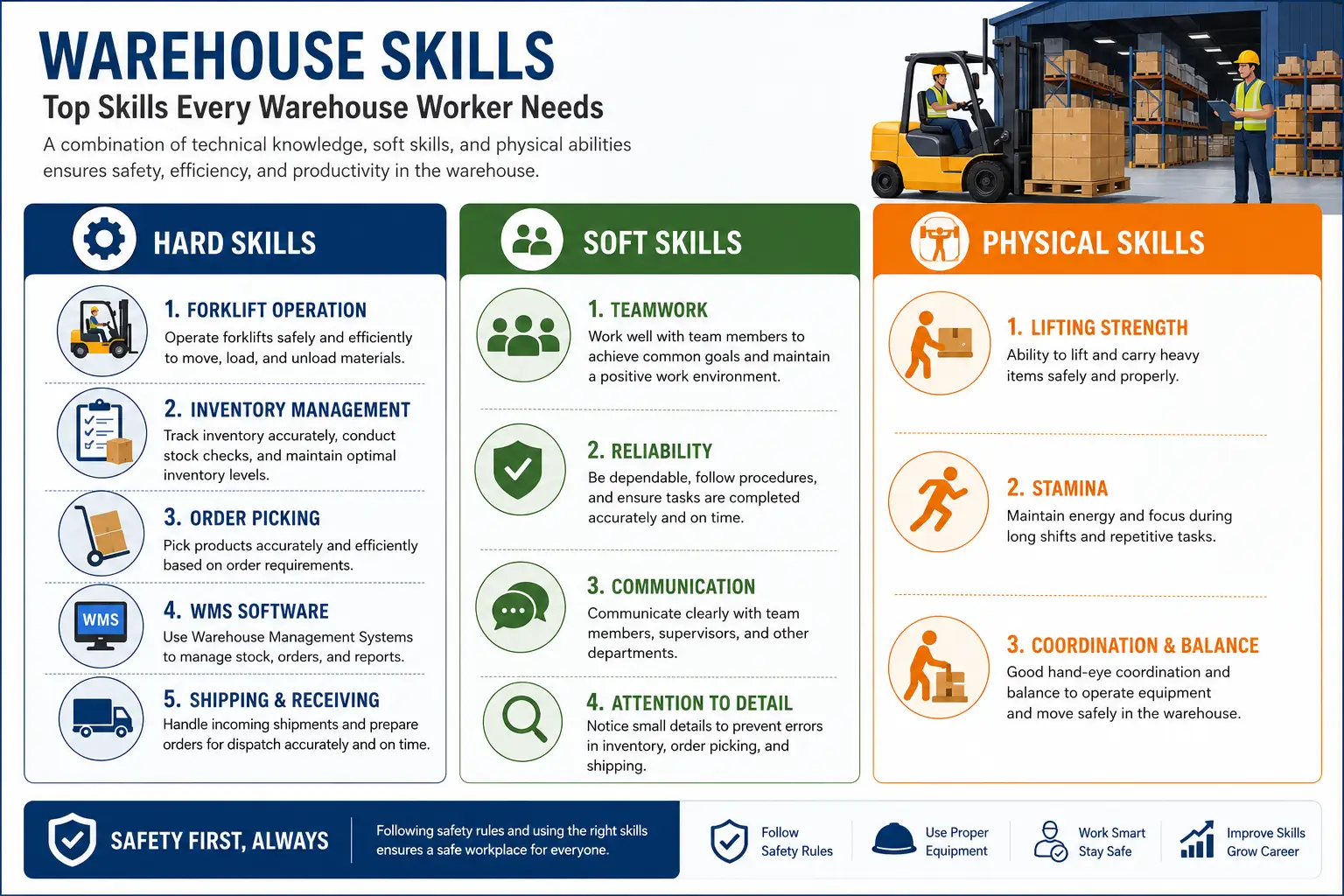
warehouse-skills-infographic-2026
Visual infographic showing the top 10 warehouse skills with icons for forklift, barcode scanner, WMS, pallet jack, safety, and more.
Top Hard Skills for Warehouse Workers (Technical Expertise)
Hard skills are the teachable, technical abilities required to perform specific warehouse tasks. These are often the first items an employer checks off when reviewing a resume. Without these hard skills, it is difficult to operate efficiently in a modern distribution center.
1. Inventory Management
Inventory management is the cornerstone of warehousing. It involves tracking stock levels, organizing goods logically, and ensuring inventory accuracy. A warehouse worker with strong inventory skills minimizes costly 'shrink' (lost or stolen goods) and ensures that products are always available to fulfill orders. On your resume, you might say: 'Maintained 99.5% inventory accuracy through weekly cycle counts and proper slotting techniques.'
2. Order Picking and Packing
Order picking is the process of retrieving items from warehouse shelves to fulfill customer orders. Packing is the careful preparation of these items for shipment. Speed and accuracy are both critical. Employers track 'picking rates' (units per hour) and 'packing accuracy' (damage rates). Demonstrating that you can meet or exceed productivity targets (e.g., 'Consistently picked 120 units per hour with zero errors') is a powerful addition to your warehouse skills list.
3. Forklift Operation and Material Handling Equipment
Forklift operation is one of the most requested certifications in any warehouse skills list. According to OSHA, forklift operators who lack proper training increase the likelihood of injury. Always list the specific equipment you have operated. For example: 'Certified on Crown and Toyota forklifts; experienced with electric pallet jacks and narrow-aisle reach trucks.' According to BLS data, the median wage for hand laborers is $18.12 per hour (May 2024), with certified forklift operators earning up to 10% more. Entry-level warehouse positions typically start at $15-18 per hour.
4. Barcode Scanner and RF Device Operation
Gone are the days of pen-and-paper inventory. Today, almost all warehouses rely on handheld Radio Frequency (RF) scanners or barcode scanners to track inventory movement in real-time. Proficiency with these devices ensures that data is captured accurately, reducing mis-shipments and improving traceability.
5. Warehouse Management Systems (WMS)
Warehouse Management Systems (WMS) are the software brains of the operation. According to Congruence Market Insights 2025, real-time WMS adoption rates are above 70% among Fortune 500 companies. The global WMS market was valued at $3.88 billion in 2025 and is projected to reach $10.64 billion by 2034. Over 65% of large warehouse operators are adopting integrated mobile and IoT solutions. Experience with major WMS platforms like SAP EWM, Oracle WMS, Manhattan Associates, or even simpler tools like ShipStation is a massive advantage. Even if you have only used a specific proprietary system, mention it under your hard skills.
6. Shipping and Receiving Procedures
Receiving involves unloading trucks, verifying incoming shipments against purchase orders, and inspecting items for damage. Shipping involves packing, labeling, and generating bills of lading (BOLs) or shipping labels. Knowledge of carrier requirements (e.g., UPS, FedEx, DHL) and documentation is a critical hard skill in this warehouse skills list.
7. Quality Control and Inspection
Quality control is the final check before an order leaves the building. Workers must be able to identify damaged, defective, or incorrect products. Highlighting your ability to maintain high quality standards reduces return rates and saves the company money.
8. Pallet Jack Operation (Manual and Electric)
While similar to forklift operation, pallet jack use is distinct. Many entry-level roles rely heavily on pallet jacks for moving skids around the floor. Being proficient with both manual 'walkie' jacks and powered 'rider' jacks is a great way to diversify your warehouse skills list and make you immediately useful on day one.
Essential Physical Skills for Warehouse Work (The Stamina Factor)
Warehouse work is physically demanding. While resumes often ignore physical capabilities, they are the unspoken prerequisite for the job. Employers often have 'fitness for duty' tests. Here are the physical components of an effective warehouse skills list.
9. Strength and Stamina
Most warehouse jobs require the ability to stand, walk, and lift for eight to twelve hours a day. The ability to lift 50 pounds (and sometimes up to 100 pounds) repetitively without fatigue is a baseline requirement. You should be honest about your physical capabilities and highlight your ability to maintain productivity throughout a long shift.
10. Hand-Eye Coordination and Fine Motor Skills
Whether you are scanning boxes, wrapping pallets, or sorting small items, hand-eye coordination is vital. Good coordination prevents mis-scans, reduces packaging waste, and speeds up repetitive tasks.
11. Flexibility and Agility
Warehouse environments often involve bending, stooping, climbing ladders, and reaching for items on high shelves. Agility allows workers to navigate safely around moving equipment (forklifts, carts) and tight aisles without injury.
Essential Soft Skills for Warehouse Workers (The Human Element)
Hard skills and physical stamina are useless without the right attitude. Soft skills are often the deciding factor between who gets promoted and who stays stagnant. According to a recent supply chain survey, the top six soft skills employers look for mirror your 'People Also Ask' query directly.
12. Attention to Detail
Picking the wrong item or shipping to the wrong address is costly. Attention to detail means double-checking SKU numbers, reading labels accurately, and verifying quantities. You can demonstrate this by saying: 'Maintained a 99.8% order accuracy rate by implementing a double-check system for high-value items.'
13. Time Management
Warehouses live and die by their throughput. Meeting shipping deadlines requires excellent time management. Workers must prioritize tasks (e.g., pulling express orders first) and work efficiently without sacrificing quality. Highlighting your ability to 'Exceed productivity standards by 15% while maintaining safety records' shows this skill.
14. Teamwork and Collaboration
No one picks, packs, and ships alone. You rely on inbound teams to stock the shelves, and they rely on you to move product out. A positive team player is willing to help others, share equipment, and step in when shifts are understaffed. Employers highly value reliability in a team setting.
15. Effective Communication
Warehouse communication is often quick and direct. You need to be able to report inventory discrepancies, safety hazards, or equipment malfunctions clearly to your supervisor or maintenance team. Good communication prevents small issues from becoming major operational breakdowns.
16. Problem-Solving and Adaptability
Warehouses are unpredictable. A conveyor might break, a shipment might arrive late, or a system might crash. Employers need workers who can think on their feet, find temporary solutions, and adapt to changing workflows without getting flustered. 'Adaptability' is one of the top 6 skills examples that consistently comes up in hiring manager interviews.
17. Reliability and Punctuality
This might seem too basic to list, but reliability is the most prized soft skill in logistics. When a team member calls out sick, it throws the entire shift schedule off. Showing up on time, consistently, and with a willingness to work overtime when needed is a massive differentiator in your warehouse skills list.
Safety Compliance and OSHA Awareness
Safety is a non-negotiable pillar in any warehouse skills list. Warehouses are among the most hazardous workplaces in terms of non-fatal injuries. According to the Government Accountability Office (GAO) and BLS data, the transportation and warehousing sector had the highest serious injury and illness rate of all 19 sectors in 2022, with an estimated 3.8 cases per 100 workers.
According to MCR Safety citing BLS data, the warehousing industry experiences 4.8 total recordable injuries for every 100 employees. That is 39% higher than the 2.9 injury average across all industries. OSHA cited warehouse employers for more than 2,500 workplace violations from FY 2018 through 2023.
Your knowledge of safety protocols (like locking out equipment, proper lifting techniques, and spill cleanup) is a hard requirement.
- Understanding of Material Safety Data Sheets (MSDS)
- Knowledge of Personal Protective Equipment (PPE) usage (steel-toed boots, safety vests, gloves)
- Fire safety and emergency evacuation procedures
- Accident reporting procedures
Warehouse Skills List by Role (Associate vs. Supervisor vs. Operator)
Your warehouse skills list should shift slightly depending on the specific role you are applying for. Here is how the emphasis changes:
Warehouse Associate / General Labor
- Order Picking and Packing
- RF Scanner Operation
- Basic Inventory Counting
- Pallet Jack Operation
- Safety Compliance
- Reliability and Teamwork
Forklift Operator / Material Handler
- Forklift / Reach Truck Certification
- Load Balancing and Stacking
- Equipment Inspection
- Narrow-Aisle Navigation
- Inventory Put-away
- Battery Changing and Charging
Warehouse Supervisor / Lead
- Workflow Optimization
- Staff Scheduling
- Performance Monitoring
- Incident Investigation
- Training and Onboarding
- WMS Reporting and Analytics
How to List Warehouse Skills on a Resume (ATS Strategy)
Knowing the skills is one thing; formatting them correctly on your resume is another. To beat the ATS (Applicant Tracking System) and get your resume in front of a human, you must place your keywords strategically.
According to a warehouse recruiter from a leading logistics firm:
> "Warehouse resume keywords are the specific skills, equipment names, and certifications that ATS systems and recruiters search for when filtering warehouse candidates."
According to Indeed Flex, the top 3 warehouse resume keywords are: inventory management, forklift operation, and shipping & receiving. Here is exactly how to list warehouse skills on a resume.
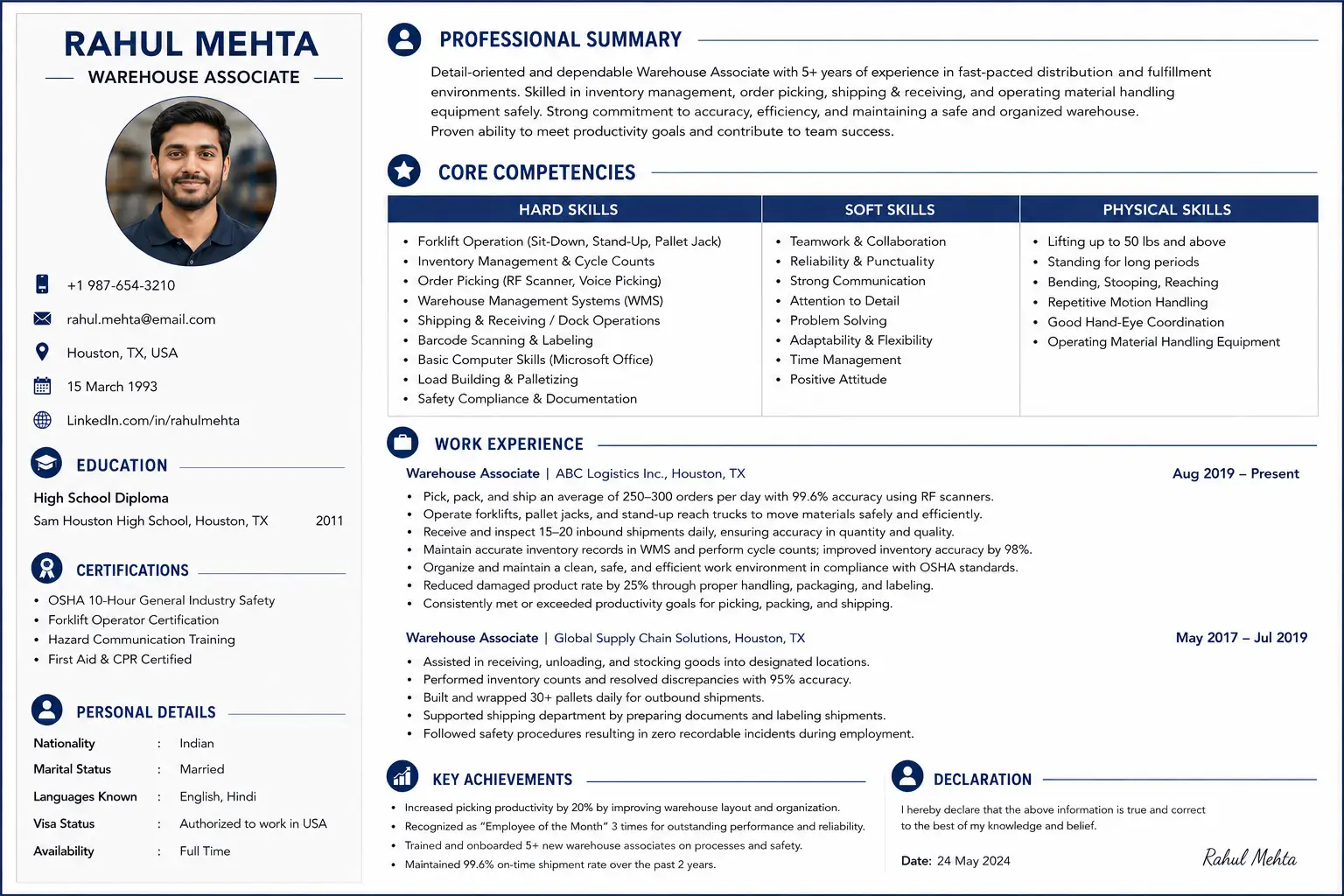
Warehouse Resume Example
Complete warehouse resume example showing professional summary with warehouse skills, core competencies section with hard and soft skills, and work experience with quantified achievements for a warehouse associate position.
Step 1: The Dedicated Skills Section
Create a separate 'Skills' or 'Core Competencies' section. Use 10 to 15 bullet points. Do not use fancy columns or tables, as they confuse the ATS. Use standard text. Example:
- Inventory Management & Cycle Counting
- Order Picking (Voice and RF Picking)
- Forklift & Reach Truck Certified
- Warehouse Management Systems (SAP EWM)
- Shipping & Receiving (BOLs, UPS, FedEx)
- Quality Control & Safety Compliance
- Pallet Jack & Material Handling
- Data Entry & RFID Systems
Step 2: The Professional Summary
Your summary is prime real estate. Weave in 3-4 of the most critical skills from the job description. Example:
"Certified forklift operator with 5 years of experience in high-volume e-commerce warehousing. Expert in inventory management, order fulfillment, and WMS software. Proven track record of meeting 99% accuracy targets and leading safety initiatives."
Step 3: Quantified Work Experience
Do not just list duties. Show how you used your skills. Pair the skill with a metric.
- Weak: 'Picked orders.'
- Strong: 'Picked and packed an average of 150 orders per shift using RF scanners, maintaining 99.5% accuracy during peak holiday seasons.'
- Weak: 'Managed inventory.'
- Strong: 'Reduced inventory discrepancies by 30% through rigorous cycle counting and process audits.'
Common Mistakes to Avoid When Listing Warehouse Skills
Many candidates sabotage themselves by making these errors. Avoid them to ensure your warehouse skills list stands out positively.
Mistake 1: Being Too Vague
Saying you are a 'hard worker' or 'fast learner' is filler. It wastes space and adds zero value to the ATS score. Be specific: 'Certified on Toyota 8FGU25 forklifts' is worth ten times more than 'Good at machinery.'
Mistake 2: Listing Outdated Skills
If you are applying for a modern automated warehouse, do not spend too much time talking about manual hand-counting unless you are also showing proficiency with automation software. Keep your skills relevant to 2026.
Mistake 3: Not Customizing for the Job Description
If the job posting specifically asks for 'Cherry Picker experience' and you have it, but you only wrote 'Lift Equipment,' you will get filtered out. Mirror the exact language of the job description in your skills list.
| Before (Weak) | After (Strong) |
|---|---|
| "Managed inventory." | "Maintained 99.5% inventory accuracy through weekly cycle counts and proper slotting techniques." |
| "Used forklifts." | "Certified on Crown and Toyota forklifts; operated daily for 4+ years with zero incidents." |
| "Picked orders." | "Picked and packed 150+ orders per shift with 99% accuracy during peak seasons." |
| "Helped with shipping." | "Processed 50+ outgoing shipments daily, maintaining 100% documentation compliance." |
| "Good team player." | "Collaborated with 15+ team members to meet daily production targets consistently." |
| "Followed safety rules." | "Maintained 100% safety compliance for 2+ years with zero lost-time incidents." |
| "Used warehouse software." | "Proficient in SAP EWM, Oracle WMS, and Manhattan Associates WMS." |
| "Worked in a warehouse." | "Managed operations in a 50,000 sq ft warehouse with 25+ team members." |
Top Certifications to Add to Your Warehouse Skills List
Certifications prove you have been formally trained and add immediate credibility to your resume. Include these in your skills list or a separate 'Certifications' section.
- OSHA 10-Hour or 30-Hour General Industry Safety
- Forklift Operator Certification (Power Industrial Trucks)
- First Aid and CPR Certification
- HAZMAT (Hazardous Materials) Endorsement
- Lean Six Sigma Yellow or Green Belt (for process improvement roles)
- Dangerous Goods (IATA/IMDG) for shipping
Future-Proofing Your Skills: What is Next for Warehousing?
Finally, it is worth looking ahead. According to Congruence Market Insights 2025, over 65% of large warehouse operators are adopting integrated mobile and IoT solutions. Over half of warehouse employers anticipate critical skills shortages in automation and robotics within five years, according to the UKWA Skills Survey 2025.
To future-proof your career, consider adding these emerging skills to your warehouse skills list as you learn them:
- AI-driven automation oversight
- Robotics maintenance (e.g., AMRs - Autonomous Mobile Robots)
- Data analysis (basic Excel or Power BI)
- Drone inventory control
As warehouses evolve, the workers who understand the technology behind the boxes will be the ones promoted.
How to Use These Skills
| Step | Action | Example |
|---|---|---|
| 1 | Identify skills from job description | "Forklift operation, inventory management, shipping" |
| 2 | List them in your skills section | "Forklift Operation, Inventory Management, Shipping & Receiving" |
| 3 | Add to your summary | "Certified forklift operator with 5+ years of experience..." |
| 4 | Include in experience bullets | "Picked and packed 150+ orders per shift..." |
| 5 | Add certifications | "OSHA Forklift Certified" |
Sources & References
- Bureau of Labor Statistics (BLS) – Employment data, job growth projections, salary data
- OSHA (Occupational Safety and Health Administration) – Safety statistics, violations
- Government Accountability Office (GAO) – Injury rate data (3.8 per 100)
- Material Handling Institute (MHI) – Labor shortage, hiring challenges (52%, 45%)
- UKWA Skills Survey 2025 – 87% employer difficulty, automation skills shortages
- Congruence Market Insights 2025 – WMS adoption (70%+ Fortune 500, 65% IoT)
- MCR Safety – Injury rate comparison (4.8 vs 2.9 average)
- Indeed Flex – Top 3 warehouse resume keywords
What skills do I need for warehouse work?
You need a balanced mix of physical abilities (stamina, lifting, hand-eye coordination), technical skills (forklift operation, WMS software, barcode scanning), and soft skills (teamwork, reliability, time management, and attention to detail). Most employers prioritize forklift certification and inventory management experience alongside a strong work ethic.
What are warehousing skills?
Warehousing skills are the combined technical, physical, and interpersonal abilities required to efficiently receive, store, manage, and ship inventory in a distribution or fulfillment center. They range from operating heavy machinery and using warehouse management systems to maintaining safety compliance and collaborating with team members to meet daily productivity targets.
What are top 6 skills examples for warehouse workers?
The top 6 warehouse skills are: 1) Inventory Management (tracking stock levels), 2) Order Picking & Packing (accuracy and speed), 3) Forklift Operation (certification and safe driving), 4) Shipping & Receiving (processing documentation), 5) Safety Compliance (OSHA standards and hazard prevention), and 6) Teamwork & Communication (coordinating with coworkers to meet deadlines).
How to list warehouse skills on a resume?
List warehouse skills in three places: 1) A dedicated 'Skills' section with 10-15 bullet points, 2) Your professional summary (weaving in 3-4 top keywords), and 3) Your work experience bullet points (backing each skill with a measurable achievement, e.g., 'Processed 150 orders per shift with 99% accuracy using RF scanners').
What are the most in-demand warehouse certifications?
The most sought-after certifications include OSHA Safety Training, Forklift Operator Certification, First Aid/CPR, Hazardous Materials (HAZMAT) Handling, and Lean/Six Sigma for process improvement. Many employers also value specific WMS software certifications like SAP EWM or Oracle WMS.
How many warehouse skills should I put on my resume?
Aim for 10 to 15 targeted skills. Including 6-8 hard skills (e.g., specific equipment or software) and 5-7 soft skills (e.g., reliability, problem-solving) provides a well-rounded profile that satisfies both ATS systems and human recruiters.
Do warehouse resumes need keywords for ATS?
Absolutely. Applicant Tracking Systems (ATS) scan for exact matches from the job description. Missing critical keywords like 'forklift certification,' 'inventory control,' or 'shipping and receiving' can automatically disqualify your resume, even with years of experience.
Conclusion: Mastering Your Warehouse Skills List for Career Growth
Creating a winning warehouse skills list is the first step toward securing a rewarding career in logistics. We have covered the top hard skills (from inventory management to forklift operation), the critical physical attributes, and the often-overlooked soft skills like reliability and communication that employers desperately need.
With 1.8 million+ warehouse employees, 4% job growth projected through 2034, and 87% of employers struggling to find skilled workers, the opportunity is clear. According to BLS data, the median warehouse pay is $18.12 per hour, with certified forklift operators earning up to 10% more.
Remember, the key to turning this knowledge into a job offer is implementation. Review the job descriptions you are targeting, pick the 10-15 most relevant keywords from this guide, and place them strategically across your resume summary, skills section, and work history. By pairing your skills with quantifiable achievements, you will not only pass the ATS but also grab the hiring manager's attention.
Take action today. Update your resume with this warehouse skills list, apply for that position you have been eyeing, and take the next step in your logistics career. The supply chain is always moving, and with the right skills, you will be leading the charge.
### 📄 Resume Format Guide
- Chronological vs Functional Resume: Which Format is Best?
- Resume Format Rules: Complete Guide for 2026
### 📚 Related Warehouse Articles
- How to List Warehouse Skills on a Resume (+ Examples)
- Warehouse Associate & Manager Skills: Role-by-Role Guide
- Warehouse Skills for Resume: How to Choose & Match
### About the Author
Ash is a resume expert and career strategist who helps job seekers land their dream roles. With years of experience in resume writing and ATS optimization, Ash has helped thousands of candidates create resumes that get noticed.
### ✅ Ready to Build Your Warehouse Resume?
📥 Use our free ATS CV Maker to create a professional, ATS-friendly warehouse resume in minutes. No sign-up required.
Need more help? Contact us for personalized resume assistance.
Comments
Loading comments…