SRE Engineer Resume: PDF Template & Skills Guide
SRE engineer resume PDF template and writing guide. Senior site reliability engineer resume tips, key skills, examples, and ATS-friendly format.

Introduction: Why Your SRE Resume Needs to Be Flawless
Site Reliability Engineering (SRE) is one of the most in-demand roles in the tech industry. Companies are increasingly recognizing that reliable systems are not optional—they are critical to customer trust, revenue, and brand reputation. According to a 2024 report by the US Bureau of Labor Statistics, employment of software developers and engineers is projected to grow 22% through 2033, with SRE roles growing even faster as organizations embrace cloud-native architectures and microservices.
However, competition for SRE roles is intense. Recruiters are overwhelmed with applications, and many candidates are filtered out before they ever reach a human reviewer. Your SRE engineer resume PDF needs to be optimized for both Applicant Tracking Systems (ATS) and human readers. This guide provides a complete SRE resume example, breaks down the essential skills and keywords, and answers the most common questions about crafting a winning site reliability engineer resume.
What is a Site Reliability Engineer (SRE)?
A Site Reliability Engineer is a software engineer who specializes in ensuring that applications and systems are reliable, scalable, and performant. The SRE role was pioneered by Google and has since become a standard in the tech industry. SREs combine software engineering skills with operations expertise to build and maintain highly reliable systems.
Key responsibilities of an SRE include:
- Designing and implementing scalable, reliable infrastructure
- Monitoring system health and performance using observability tools
- Managing incident response and post-mortem analysis
- Automating operational tasks to reduce toil
- Defining and tracking Service Level Indicators (SLIs) and Service Level Objectives (SLOs)
- Collaborating with development teams to improve system reliability
- Implementing chaos engineering and resilience testing
The SRE Golden Signals: What Recruiters Look For
Recruiters and hiring managers in the SRE space are familiar with Google's Four Golden Signals—the key metrics that define system reliability. Your SRE resume should demonstrate your experience with these metrics:
- Latency: The time it takes for a system to respond to a request. Example: 'Reduced average API latency from 250ms to 120ms.'
- Traffic: The volume of requests hitting your systems. Example: 'Managed infrastructure for 10M+ daily active users.'
- Errors: The rate of failed requests. Example: 'Reduced error rate from 0.5% to 0.05%.'
- Saturation: How full your system resources are. Example: 'Optimized resource utilization to maintain < 70% CPU saturation during peak loads.'
Including these metrics with specific numbers demonstrates that you understand the core principles of SRE and can apply them in practice. Your site reliability engineer resume should not just list tools—it should show how you used them to improve these four golden signals.
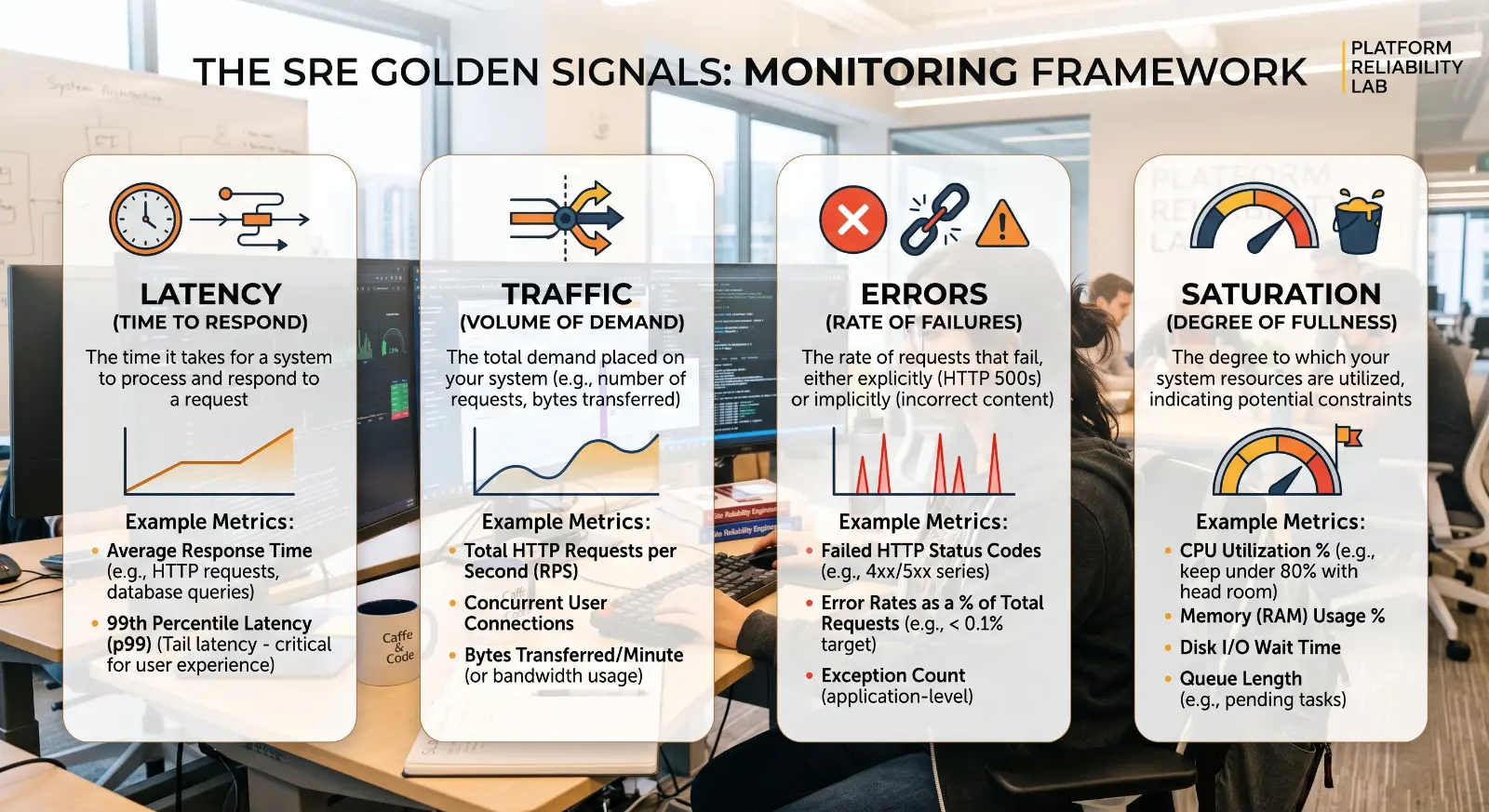
SRE Golden Signals Infographic
Visual infographic explaining Google's Four Golden Signals for SRE: latency, traffic, errors, and saturation with example metrics.
SRE Resume Example: Complete PDF-Ready Template
Below is a complete site reliability engineer resume example that is formatted for PDF submission. This template is ATS-friendly, includes all the key SRE skills, and demonstrates how to quantify your achievements. Use this as your SRE engineer resume PDF template.
Contact Information
James Anderson
Senior Site Reliability Engineer
- San Francisco, CA 94105
- (555) 987-6543
- james.anderson@email.com
- LinkedIn: linkedin.com/in/jamesandersonsre
- GitHub: github.com/jamesandersonsre
Professional Summary
Senior Site Reliability Engineer with 8+ years of experience designing and maintaining highly available, scalable infrastructure for Fortune 500 companies. Expert in Kubernetes, AWS, Terraform, and observability tools (Prometheus, Grafana, Datadog). Proven track record of improving system reliability from 99.9% to 99.99% availability, reducing latency by 40%, and automating operational tasks to reduce toil by 60%. Passionate about incident response, chaos engineering, and building resilient distributed systems.
Core Competencies
- Kubernetes and Docker
- AWS (EC2, EKS, Lambda, VPC)
- GCP and Azure
- Terraform and Ansible
- Python, Go, and Bash
- Prometheus, Grafana, Datadog
- CI/CD (Jenkins, GitLab CI, ArgoCD)
- Incident Response and Post-Mortems
- SLI/SLO Management
- Distributed Systems
- Service Mesh (Istio, Linkerd)
Professional Experience
Senior Site Reliability Engineer | CloudTech Solutions | 2022-Present
- Led SRE initiatives for a microservices platform serving 5M+ daily active users, improving system availability from 99.9% to 99.99% (reducing downtime from 8.7 hours to 52 minutes annually).
- Designed and implemented Kubernetes clusters using EKS and Terraform, supporting 200+ microservices and reducing deployment time by 60%.
- Built observability pipelines using Prometheus, Grafana, and Datadog, creating SLI dashboards that reduced mean time to detection (MTTD) by 50%.
- Automated incident response runbooks using Python and PagerDuty APIs, reducing mean time to resolution (MTTR) from 45 to 18 minutes.
- Led monthly chaos engineering exercises using Gremlin, identifying 15+ failure modes and proactively strengthening system resilience.
- Mentored 5 junior SREs and conducted training on reliability best practices, incident management, and post-mortem culture.
Site Reliability Engineer | DataFlow Systems | 2019-2022
- Managed AWS infrastructure for a high-growth fintech platform, handling 1M+ daily transactions with 99.95% uptime.
- Migrated 50+ legacy services from EC2 to Kubernetes (EKS), reducing infrastructure costs by 30% and improving scalability.
- Implemented CI/CD pipelines using GitLab CI and ArgoCD, enabling 50+ daily deployments with zero downtime.
- Developed custom Terraform modules for infrastructure provisioning, reducing provisioning time from 2 hours to 15 minutes.
- Established SLOs and error budgets for 5 critical services, collaborating with development teams to improve code quality and system reliability.
Software Engineer (DevOps) | Innovative Systems | 2017-2019
- Built and maintained CI/CD pipelines using Jenkins, reducing build time from 12 minutes to 4 minutes.
- Managed Linux servers and configuration using Ansible, achieving 99.99% system uptime across 100+ servers.
- Collaborated with development teams to containerize applications using Docker and deploy to Kubernetes clusters.
- Created monitoring dashboards using Grafana and Prometheus, providing real-time visibility into system health.
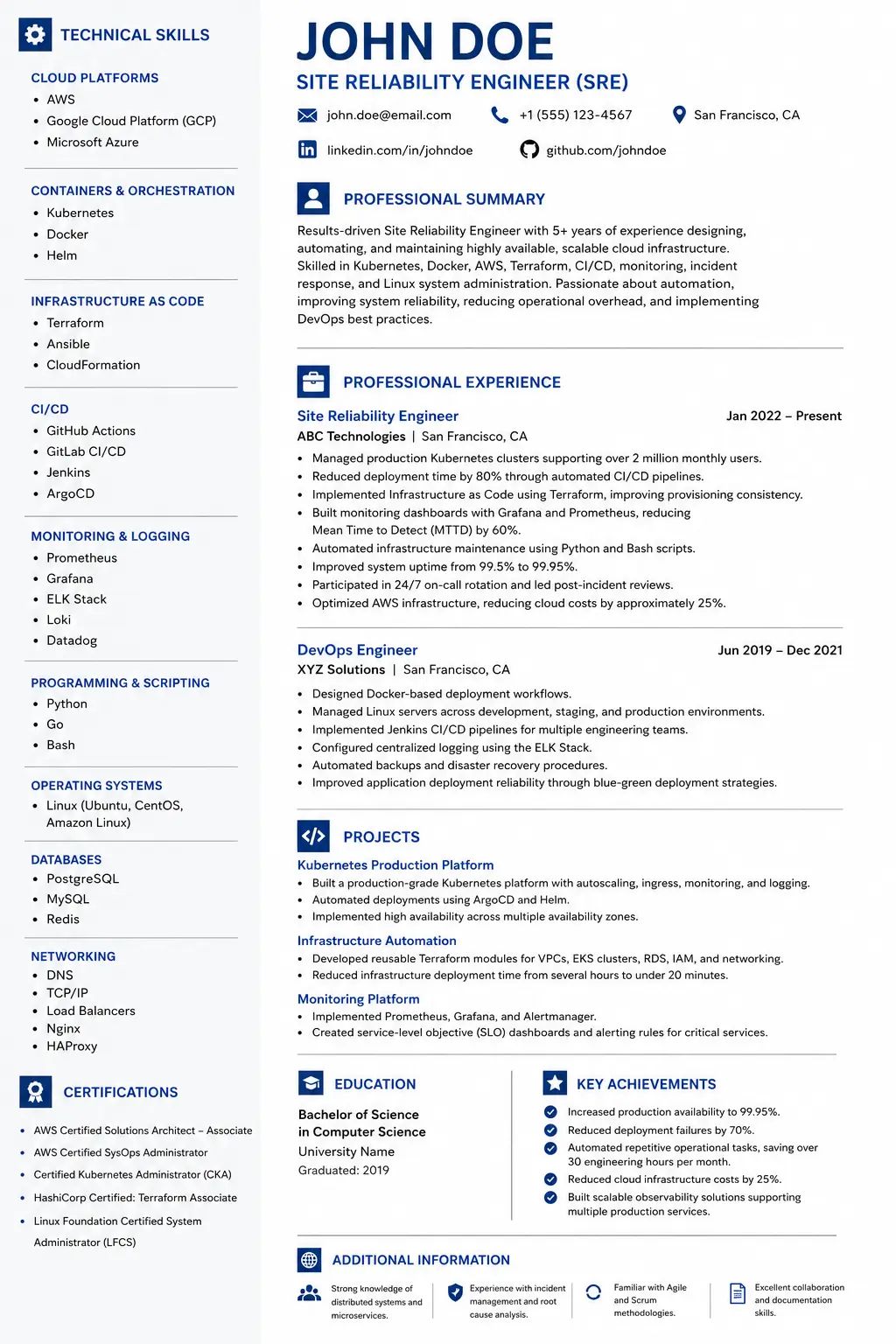
SRE Engineer Resume PDF Template Example
Full 2-page SRE resume example formatted for PDF submission with clear section headers, quantified achievements, and ATS-friendly structure.
Education and Certifications
- MS in Computer Science, Stanford University (2017)
- BS in Computer Engineering, UC Berkeley (2015)
- Certified Kubernetes Administrator (CKA)
- AWS Certified Solutions Architect – Professional
- HashiCorp Certified: Terraform Associate
Technical Skills
- Kubernetes and Docker
- AWS, GCP, Azure
- Terraform and Ansible
- Python, Go, Bash
- Prometheus, Grafana, Datadog
- Jenkins, GitLab CI, ArgoCD
- Istio and Linkerd
- Linux and Networking
Essential SRE Resume Keywords and Skills
To ensure your SRE engineer resume PDF passes ATS screening, include these key skills and keywords throughout your resume:

SRE Skills and Tools Matrix
Comprehensive matrix of SRE skills including cloud platforms (AWS, GCP, Azure), observability tools (Prometheus, Grafana, Datadog), CI/CD tools, and automation skills.
IMAGE PLACEHOLDER 3: Add a visual matrix or infographic here showing SRE skills categorized by cloud platforms, observability tools, CI/CD, automation, and core SRE competencies.
Infrastructure and Cloud
- AWS (EC2, EKS, Lambda, S3, VPC, RDS)
- GCP (GKE, Compute Engine, Cloud Functions)
- Azure (AKS, VM, Storage)
- Kubernetes and Docker
- Terraform and Ansible
- Linux Administration
- Networking (TCP/IP, DNS, Load Balancing)
Observability and Monitoring
- Prometheus and Grafana
- Datadog
- New Relic
- ELK Stack (Elasticsearch, Logstash, Kibana)
- Splunk
- OpenTelemetry
- Jaeger and Zipkin
CI/CD and Automation
- Jenkins
- GitLab CI/CD
- GitHub Actions
- ArgoCD
- Flux
- Python Scripting
- Go Programming
SRE Specific Skills
- SLI (Service Level Indicators)
- SLO (Service Level Objectives)
- Error Budgets
- Incident Response
- Post-Mortem Analysis
- Chaos Engineering
- Capacity Planning
How to Write a Senior Site Reliability Engineer Resume
If you are applying for a senior site reliability engineer role, your resume must demonstrate not just technical proficiency, but also leadership, mentorship, and strategic thinking. Here are key tips for crafting a senior SRE resume:
- Lead with Leadership: Highlight team management, mentorship, and cross-functional collaboration.
- Quantify Impact: Include metrics like availability improvements, latency reductions, and cost savings.
- Show System Design: Demonstrate that you can design scalable, resilient systems from the ground up.
- Emphasize Incident Management: Show your experience leading incident response and post-mortem processes.
- Include Mentorship: Mention training junior engineers or leading SRE onboarding.
- Highlight Strategic Initiatives: Example: 'Led the migration of 200+ microservices from EC2 to Kubernetes.'
SRE Resume Writing Tips for Maximum Impact
1. Start with a Strong Professional Summary
Your professional summary is the first thing a recruiter reads. It should immediately communicate your experience level, key skills, and most impressive achievement. Use the phrase 'site reliability engineer resume' or 'sre resume' naturally.
Example: 'Senior Site Reliability Engineer with 8+ years of experience designing highly available infrastructure for Fortune 500 companies. Expert in Kubernetes, AWS, and Terraform. Improved system availability from 99.9% to 99.99% and reduced latency by 40%.'
2. Quantify Everything
At the SRE level, vague statements are unacceptable. Every major achievement should include a metric. Examples: 'Reduced MTTR from 45 to 18 minutes,' 'Improved availability from 99.9% to 99.99%,' 'Reduced infrastructure costs by 30%,' 'Managed 10M+ daily active users.'
3. Show the Golden Signals
Recruiters and hiring managers in the SRE space actively look for the Four Golden Signals: latency, traffic, errors, and saturation. Demonstrate your experience with these metrics in your bullet points.
4. Include Certifications
Certifications are highly valued in the SRE space. Include CKA (Certified Kubernetes Administrator), AWS Solutions Architect, Google Professional Cloud Architect, or HashiCorp Terraform Associate. These demonstrate your technical credibility and commitment to the discipline.
5. Save as PDF for Submission
Always save your SRE engineer resume as a PDF before submitting. PDFs preserve your formatting, ensuring that your carefully structured resume looks exactly as you intended. However, check the job posting—some ATS systems prefer Word documents.
Common Mistakes to Avoid on Your SRE Resume
- Focusing only on tools without showing how you used them to improve reliability
- Failing to quantify achievements with metrics
- Using generic language like 'team player' or 'hard worker' without evidence
- Including too many responsibilities and not enough outcomes
- Ignoring the Four Golden Signals
- Forgetting to include incident response experience
- Using an unprofessional email address or missing portfolio/GitHub links
ATS Tips for Your SRE Resume PDF
To ensure your SRE engineer resume PDF passes ATS screening:
- Use standard section headers (Professional Experience, Education, Skills)
- Include keywords from the job description
- Avoid tables, columns, and complex formatting
- Use bullet points for experience
- Save as PDF (unless instructed otherwise)
- Include both acronyms and full forms (e.g., 'CI/CD (Continuous Integration / Continuous Delivery)')
- Ensure your resume is scannable with clear hierarchy
Conclusion: Build an SRE Resume That Gets Hired
A well-crafted SRE engineer resume PDF is your ticket to landing an interview in one of tech's most competitive fields. By strategically incorporating the right keywords, quantifying your achievements, and demonstrating your understanding of core SRE principles like the Four Golden Signals, you create a resume that passes ATS filters and resonates with hiring managers.
Remember these key takeaways:
- Lead with a strong professional summary that hooks the reader
- Quantify every significant achievement with metrics
- Show your experience with the SRE Golden Signals
- Include certifications that demonstrate your credibility
- Tailor your resume to each specific job description
- Save your resume as a PDF for professional formatting
Your next SRE role is waiting. Build a resume that gets noticed and opens doors.
What should an SRE resume include?
An SRE resume should include a professional summary, core competencies (Kubernetes, AWS/GCP/Azure, Terraform, Python/Go), technical experience with quantified achievements (reducing latency, improving availability), certifications (CKA, AWS Solutions Architect), and the SRE Golden Signals (latency, traffic, errors, saturation). It should also highlight incident response experience and automation projects.
What is the difference between an SRE and DevOps resume?
An SRE resume emphasizes reliability, observability, SLIs, SLOs, and error budgets, while a DevOps resume focuses more on CI/CD pipelines, automation, and deployment frequency. SRE roles are more operations and reliability-focused, whereas DevOps is broader across the entire software delivery lifecycle. SRE resumes also highlight incident management and post-mortem analysis.
What are the key skills for a site reliability engineer?
Key SRE skills include Kubernetes, Docker, AWS/GCP/Azure, Terraform, Ansible, Python, Go, Prometheus, Grafana, Datadog, New Relic, CI/CD (Jenkins, GitLab CI, ArgoCD), incident response, observability, SLI/SLO management, and distributed systems. Soft skills like communication, collaboration, and problem-solving are equally important.
How do I make my SRE resume ATS-friendly?
To make your SRE resume ATS-friendly, use standard section headers (Professional Experience, Education, Skills), include keywords from the job description (Kubernetes, Terraform, Prometheus, etc.), avoid tables and columns, save as a PDF (unless instructed otherwise), and quantify your achievements with metrics like 'reduced latency by 40%' or 'improved availability to 99.99%.'
What certifications should I include on my SRE resume?
Top SRE certifications include Certified Kubernetes Administrator (CKA), AWS Certified Solutions Architect, Google Professional Cloud Architect, Azure Administrator, Prometheus Certified Associate, and HashiCorp Certified: Terraform Associate. These demonstrate your technical credibility and commitment to the SRE discipline.
### 📄 Resume Format Guide
- Chronological vs Functional Resume: Which Format is Best?
- Resume Format Rules: Complete Guide for 2026
Comments
Loading comments…