Resume vs Cover Letter: Which One Do Employers Need?
Resume vs cover letter vs CV explained: what employers actually read, real data on callback rates, and when you need each document.
Introduction
Many job seekers use the terms resume, cover letter, and CV interchangeably, but they serve different purposes — and in the case of "CV," the term itself means something different depending on where you're applying. Understanding these distinctions can help you create stronger job applications and avoid sending the wrong document to the wrong employer.
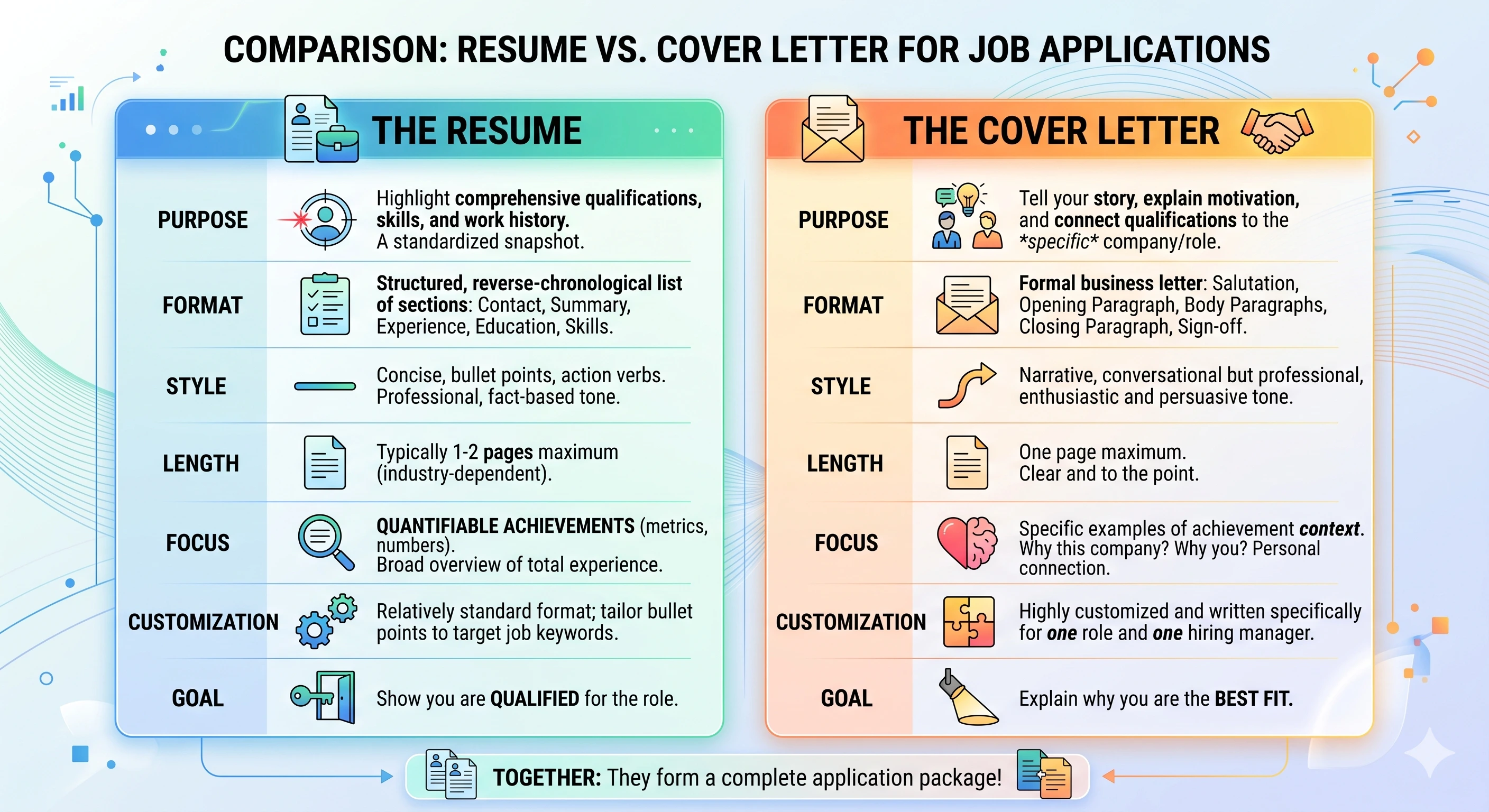
A resume provides a structured, bullet-point overview of your work experience, education, skills, and accomplishments. A cover letter is a paragraph-format letter that introduces you, explains your interest in a position, and connects your background to the employer's needs. According to Sam DeMase, career expert at ZipRecruiter, a cover letter is "the most human part of the initial hiring process before the interview" — it reveals things a resume alone can't, like soft skills and cultural fit.
A CV is where things get genuinely confusing, because the term means two different things depending on your country and field. This guide covers all three documents: what each one is, when employers expect them, and what real data says about how they're actually read.
What Is a Resume?
A resume is a professional document that summarizes your qualifications, work history, education, certifications, and skills. Its primary purpose is to help employers quickly assess whether you meet the requirements for a specific position.
Most resumes include:
- Contact information
- Professional summary
- Work experience
- Education
- Skills
- Certifications or licenses
- Relevant achievements
The commonly cited figure for how long a recruiter spends on an initial resume scan comes from eye-tracking studies by Ladders (formerly TheLadders) — 6 seconds in 2012, updated to 7.4 seconds in 2018. It's worth using this figure with some caution: the original 2012 study tracked only 30 recruiters, and both waves measured an initial sorting glance, not full reading time. As The Interview Guys put it, that fast scan "filters you out" — a separate, longer review later "verifies you in." Either way, the practical takeaway holds: resumes should be concise, easy to scan, and tailored to the job being applied for.
Purpose of a Resume
The main goal of a resume is to present factual, structured information about your professional background. It provides hiring managers with a snapshot of your qualifications and helps determine whether you should move forward in the hiring process.
What Is a Cover Letter?
A cover letter is a personalized document submitted alongside a resume. It allows candidates to explain their interest in a position, highlight relevant experience, and demonstrate how their skills align with the employer's needs.
Unlike a resume, a cover letter is written in paragraph format and uses a more conversational tone while maintaining professionalism.
Most cover letters include:
- A professional greeting
- An introduction
- Relevant qualifications and achievements
- Reasons for applying
- A closing statement and call to action
Purpose of a Cover Letter
A cover letter adds context to your resume. According to Stephen Dwyer, president of the American Staffing Association, more than three in ten job applicants don't write cover letters at all — which he frames as a competitive advantage for those who do. It helps employers understand not only what you've done but also why you're interested in the role and how you can contribute.
What Is a CV? (And Why It Means Different Things in Different Countries)
"CV" is the source of most of the confusion in this comparison, because it has two genuinely different meanings depending on where you are.
In the US and Canada: according to Princeton University's Center for Career Development, a CV (Curriculum Vitae, Latin for "course of life") is an exhaustive academic document used specifically for roles in academia, scientific research, and medicine. Unlike a resume, a CV has no length limit — the UC Davis Career Center notes an experienced professor or researcher's CV can run 5, 10, or even 20+ pages — and it always includes a full list of publications, research, grants, presentations, teaching experience, and references, none of which belong on a standard resume.
Outside the US and Canada: in the UK, Ireland, most of mainland Europe, Australia, and New Zealand, "CV" is simply the standard local term for what Americans call a resume — typically around two pages, not an academic document at all.
When a US-based candidate actually needs a CV instead of a resume:
- Academic positions (professor, postdoc, lecturer)
- Scientific, medical, and research roles
- Some government research labs and federal science positions
- Grant, fellowship, or graduate/PhD program applications
- International applications outside the US and Canada
Resume vs Cover Letter vs CV: Key Differences
| Resume | Cover Letter | CV (US/Canada academic sense) | |
|---|---|---|---|
| Purpose | Structured summary of qualifications | Explains interest and fit for the role | Exhaustive academic/research record |
| Format | Bullet points, sections | Paragraphs, business letter format | Detailed sections, academic conventions |
| Length | 1-2 pages | One page, 3-4 paragraphs | No limit — often 5-20+ pages |
| Includes references? | No | No | Always |
| Used for | Nearly all professional roles | Alongside a resume, when requested or advantageous | Academia, medicine, research, fellowships |
Customization
While resumes should be tailored for each role, cover letters often require even greater customization, since they address a specific employer and position directly. Nicole Gable, president of LHH Recruitment Solutions, notes that with more candidates using AI to draft materials, recruiters are increasingly seeing "the same templated, impersonal language nonstop" — what actually stands out isn't avoiding AI tools, but avoiding genericness.
When Do You Need a Resume?
A resume is required for nearly all professional job applications.
Employers typically request resumes when:
- Applying online
- Submitting applications through job boards
- Applying through recruiters
- Attending career fairs
- Applying directly through company websites
When Do You Need a Cover Letter? What the Data Actually Shows
The data on cover letters genuinely conflicts, and it's worth seeing both sides rather than a single confident number.
The strongest evidence comes from a real field experiment, not a survey. ResumeGo submitted 7,287 fictitious applications to real job postings and tracked callback rates:
- No cover letter: 10.7% callback rate
- Generic cover letter: 12.5% callback rate
- Tailored cover letter: 16.4% callback rate — a 53% higher callback rate than sending nothing
Peter Yang, CEO of ResumeGo, summarized the key finding: tailored cover letters are far superior to generic ones for boosting an applicant's chances of being hired. A 2023 Resume Genius survey of 625 U.S. hiring managers similarly found 83% read the majority of cover letters they receive, and 72% expect one even when it's listed as optional. Jobscan's analysis of roughly 1 million applications found candidates who included a cover letter were 1.9 times more likely to be invited to interview.
On the other hand, not every source agrees — a Novoresume survey of HR professionals found recruiters specifically (as opposed to hiring managers) are the group least likely to read cover letters, and other surveys report a meaningful share of hiring managers skip them entirely. In France, the labor agency APEC found that only about half of companies still requested a cover letter in 2024, down from roughly 80% in 2020 — a sign that norms may be loosening even where the document remains valuable when read.
Consider including a cover letter when:
- The employer specifically requests one
- You're applying for a competitive or senior role
- You're changing careers
- You have employment gaps to explain
- You want to demonstrate strong, specific interest in the company
- You're applying for leadership positions
Can You Submit a Resume Without a Cover Letter?
Yes, many employers accept applications that include only a resume, especially through online systems. But given that a tailored cover letter measurably improved callback rates in a real, controlled study, submitting one — when the option exists — is a low-cost way to differentiate yourself, particularly as recruiters describe being flooded with near-identical applications.
Can You Submit a Cover Letter Without a Resume?
In most cases, no. Employers rely on resumes to review work history, qualifications, and skills in a structured, scannable format. A cover letter supports a resume but rarely replaces it. Unless specifically instructed otherwise, always submit a resume when applying for a position.
How a Resume and Cover Letter Work Together
The strongest job applications use both documents effectively.
Your resume provides the facts: employment history, education, certifications, skills, and accomplishments.
Your cover letter provides the story behind those facts: why you're interested in the position, why you're applying to that company, how your experience relates to the role, and what value you can bring.
Together, these documents create a more complete picture of your qualifications — and, as Joel Schwartzberg wrote in a Harvard Business Review piece on the topic, cover letters still matter even when they're not strictly required.
How ATS Systems Handle Resumes vs Cover Letters
Resumes are consistently parsed by applicant tracking systems. iCIMS, one of the largest ATS platforms, powers hiring for thousands of employers and uses resume-parsing technology to extract your name, contact details, skills, work history, and education automatically.
Cover letters are a different story — parsing is inconsistent and platform-dependent. iCIMS notes that ATS "screen for keywords found in a candidate's resume and supporting materials, including cover letters," but whether a given system actually scores your cover letter's content, or simply stores it for a human to read later, depends heavily on the platform and how the employer configured it. As Jobscan summarizes it: companies scan cover letters, but recruiters read them.
Formatting best practices for both documents:
- Use a clean, single-column layout with standard fonts (Arial, Calibri, Times New Roman)
- Avoid tables, columns, text boxes, and graphics that can confuse parsers
- When a portal offers a paste-in text field, use it — pasted text often parses more reliably than uploaded files
- Mirror keywords from the job description in both documents
AI, Application Volume, and What's Changing in 2025-2026
Two trends are reshaping how resumes and cover letters get read. First, application volume has surged: LinkedIn reported roughly 11,000 applications submitted per minute on its platform in 2025, a 45% increase year over year, as AI tools make applying to more jobs faster. Recruiter Hung Lee has described it as an "applicant tsunami" that's only getting bigger, with popular roles drawing hundreds of applications within days.
Second, AI-written materials are now common enough that employers can rarely tell the difference. A ResumeBuilder.com blind test of 1,000 U.S. hiring managers found 82% could not identify which cover letters were written by ChatGPT. What actually stands out to reviewers, according to LHH's Nicole Gable, isn't whether a tool was used — it's whether the result still reads as generic and templated rather than specific to the role and company.
Common Resume and Cover Letter Mistakes
Repeating the Same Information
One of the biggest mistakes candidates make is copying resume content directly into a cover letter. Your cover letter should expand on key experiences rather than repeat them word for word.
Using Generic Content
Employers can quickly recognize generic applications, and with AI-generated drafts becoming common, genericness — not AI use itself — is what now stands out negatively. Customize both documents to match the position and company.
Sending a CV When a Resume Was Requested (or Vice Versa)
If a US employer asks for a resume, sending an academic-style CV with a full publication list and no length limit will work against you outside of academic or research contexts. Conversely, if an international employer or an academic search committee asks for a CV, a truncated one-page resume can look underqualified for the format they expect.
Poor Formatting
Inconsistent formatting can make documents difficult to read, appear unprofessional, and confuse ATS parsers.
Grammatical and Spelling Errors
Even small mistakes can negatively impact first impressions. Always proofread your application materials before submitting them.
Tips for Writing a Strong Resume and Cover Letter
Tailor Both Documents
Customize your resume and cover letter for every application — the callback-rate data above shows tailoring specifically, not just including a cover letter, is what drives results.
Use Keywords From the Job Description
Including relevant keywords can help your application perform better in applicant tracking systems.
Focus on Relevant Achievements
Highlight accomplishments that demonstrate value to the employer, not just a list of duties.
Keep Formatting Professional
Use clean layouts, readable fonts, and consistent formatting across both documents.
Proofread Carefully
Review your documents multiple times before submission.
Sources & References
- Princeton University Center for Career Development – CV vs. Resume Guide
- UC Davis Career Center – Resume vs CV
- Ladders (TheLadders) – Recruiter eye-tracking studies (2012, 2018)
- Forbes, "Hiring Experts Explain Why Cover Letters Still Matter," Joseph Liu (Nov. 2025) – Named hiring-expert commentary
- ResumeGo – 7,287-application field experiment on cover letter callback rates
- Resume Genius – 625 U.S. hiring manager survey
- Jobscan – ATS parsing and cover letter analysis
- iCIMS – Applicant tracking system guidance
- ResumeBuilder.com – AI-written cover letter blind test
Conclusion
Understanding the differences between a resume, cover letter, and CV is essential for creating effective job applications — and for making sure you send the right document to the right employer. A resume provides a structured overview of your experience; a cover letter explains your interest and fit, with real data showing tailored letters measurably improve callback rates; and a CV, in the US academic sense, is a different document entirely, reserved for academia, research, and medicine. Rather than competing with one another, these documents work together to present a complete picture of your professional background. By tailoring each one to the opportunity in front of you, you improve your chances of capturing an employer's attention and securing more interviews.
About the Author
Ash is a resume expert and career strategist who helps job seekers land their dream roles. With years of experience in resume writing and ATS optimization, Ash has helped thousands of candidates create resumes that get noticed. Ash's work has been featured in leading career publications and is trusted by job seekers worldwide.
### 📄 Resume Format Guide
- Chronological vs Functional Resume: Which Format is Best?
- Resume Format Rules: Complete Guide for 2026
Comments
Loading comments…